Close with Amna
Five minutes to a signed Texas contract, not twenty
Texas agents lose two to three hours a transaction to paperwork. We built the contract app that does the deadline arithmetic instead of leaving it to the agent.
- Industry
- Real estate
The challenge
Texas agents lose two to three hours per transaction to paperwork spread across DocuSign, MLS data and the wrong form versions. That is the sentence the whole product was built against, and the important word in it is “spread”. No single one of those tools is slow. The time disappears in the gaps between them, where a human copies a number out of one system and types it into another.
Close with Amna was built on TREC 20-18, the contract a Texas residential sale runs on.
An agent does not get to redesign that form, shorten it, or decide whichparts of it apply. What an agent does get wrong is what hangs off it: the dates. An option period miscounted by a single day is not a filing error. It is the buyer’s right to walk, gone.
There are more than 150,000 licensed agents in Texas, and the tools they use today cost more and do less. That is a large market with a specific, boring, repeated failure in the middle of it, which is the best kind of thing to build for.
What the audit found
The signature was never the bottleneck. The arithmetic was.
Two rules make the point on their own. The option period end date is strict: it is counted from the effective date and it does not extend over a weekend. The earnest money due date does extend, to the next business day. Those two deadlines sit inside the same contract, in the same week, governed by opposite rules, and an agent counting on a phone calendar between showings has to hold both of them correctly.
Nothing in the incumbent stack decides either one. DocuSign will route acontract with the wrong dates in it just as willingly as the right ones, and it will collect signatures on both.
The same pattern repeats everywhere in the form. Sales price is split across 3A and 3B, cash and financed, and the two have to reconcile against each other and against a down payment that has to clear conventional limits. Which Paragraph 22 addenda attach is not a preference, it is a decision tree driven off the buyer’s profile, and attaching the wrong set produces a contract that is incomplete rather than wrong, which is harder to notice.
Once that was written down, the design question changed. It stopped being “how do we make signing faster” and became “how much of this can the app decide before a signature is ever requested”.
How we rebuilt it
The contract wizard. The TREC form auto-fills, and the sales price fields calculate rather than collect. 3A and 3B are computed together, and the down payment is checked against conventional limits as the numbers are entered, so a deal that cannot finance the way the agent thinks it can surfaces while there is still time to restructure it.
The deadline engine. Option period end date, no weekend extension, strict. Earnest money due date extended to the next business day. Closing-date math per Texas law. The rules are encoded once in the app rather than recalled every time by whoever is holding the phone, which is the entire difference between a tool and a form.
The addendum tree. Paragraph 22 is driven off the buyer profile. The agent answers questions about the buyer and the app resolves which addenda belong to this specific contract, instead of the agent recalling a list under time pressure.
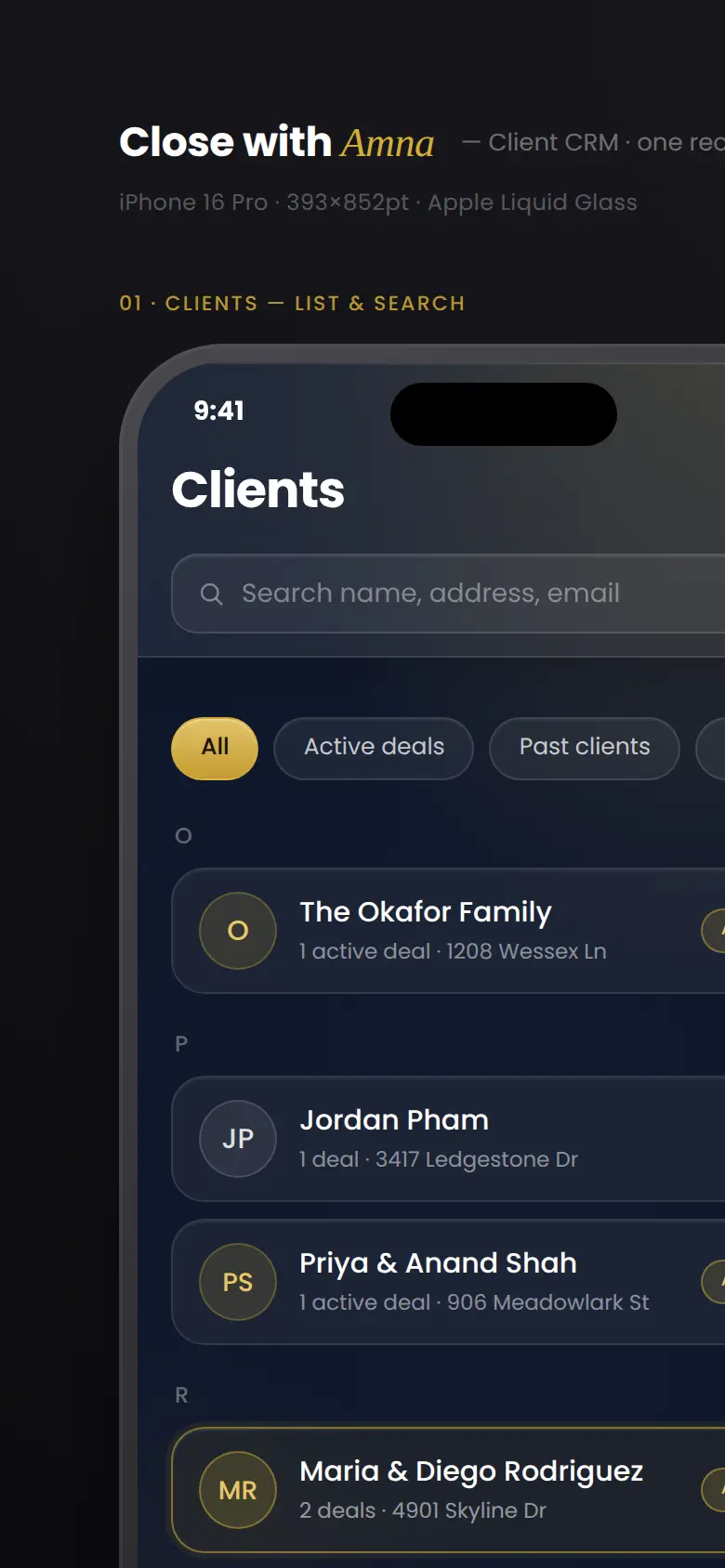
The client CRM. Every deal and every signer in one place, with the whole transaction living inside the record rather than scattered across an inbox, a signing platform and an MLS export.
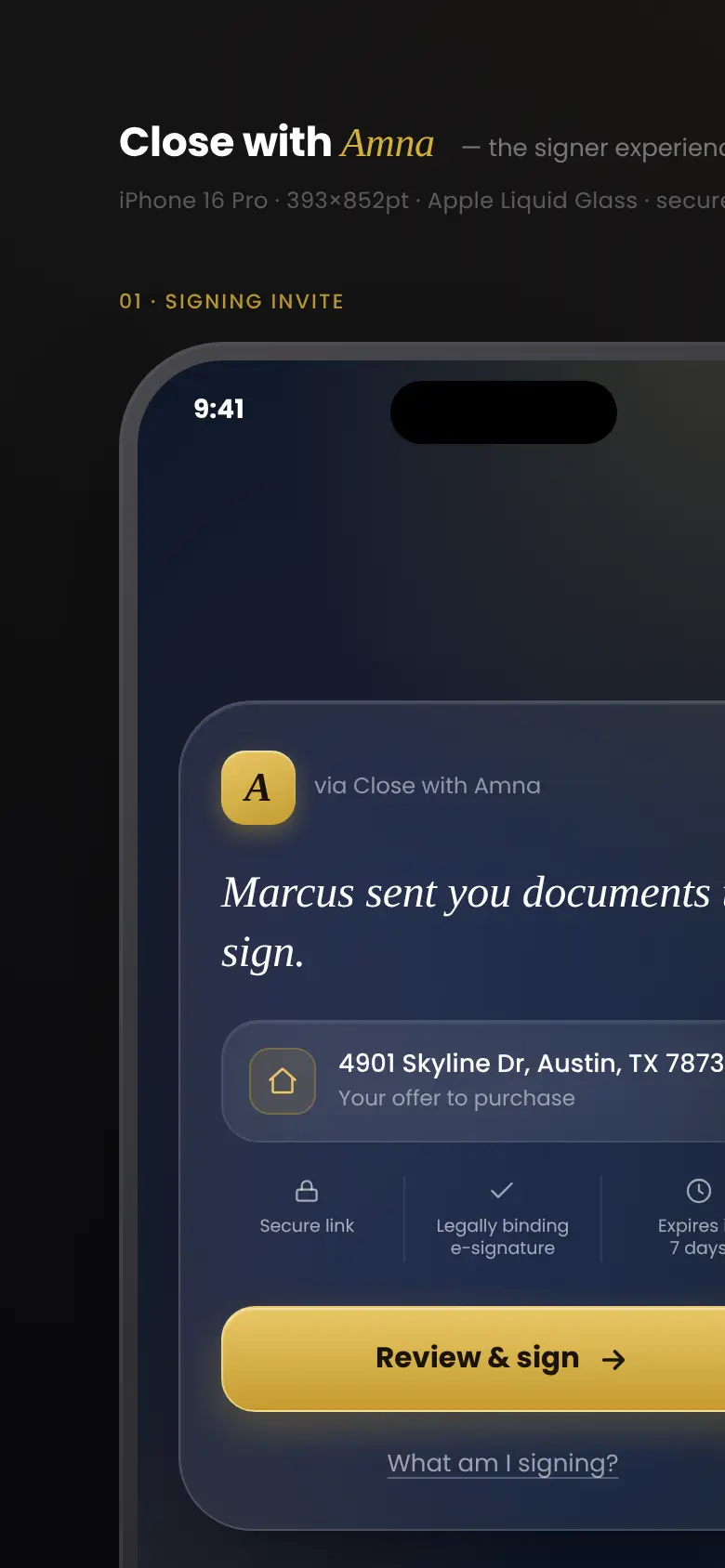
The signing. One click, on a phone. The other side of the deal reviews and signs from the device they already have in their hand, which is where the five minutes finally lands.
What it is. Close with Amna is a finished, clickable prototype and a written plan. It is not a shipped product with users. The wizard runs, the math runs, the screens are real, and no live Texas transaction has closed inside it. That distinction is worth more than it costs: a prototype that proves the hard part beats a launched app that skipped it, but only if nobody pretends it is the launched app.
The deliverables
- iOS app design and build, mobile first
- Contract wizard built on TREC 20-18 with auto-filled forms
- Option period end date computed strictly, with no weekend extension
- Earnest money due dates that extend to the next business day
- Paragraph 22 addendum decision tree driven off the buyer profile
- Sales price 3A and 3B auto-calculated, with a down-payment check against conventional limits
- One-click mobile signing for the other side of the deal
- A client CRM where the whole deal lives, every deal and every signer
The results
- 5
- Minutes to complete a transaction in the prototypeMeasured August 2026
- 20+
- Minutes the same transaction takes in DocuSignMeasured August 2026
- 2 to 3
- Hours Texas agents lose to paperwork per transactionMeasured August 2026
- 150,000+
- Licensed agents in the Texas marketMeasured August 2026
- 4
- Deadline and math rules encoded in the wizardMeasured 15 August 2026
What the numbers say
Close with Amna completes a Texas residential transaction in five minutes, against more than twenty minutes for the same transaction in DocuSign. That is the whole case for the product in one line, and it is a comparison of the finished prototype against the incumbent path, not an average pulled from a fleet of live users.
The size of the problem behind it: Texas agents lose two to three hours per transaction to paperwork spread across DocuSign, MLS data and the wrong form versions, in a state that licenses more than 150,000 of them. Two hours per deal is not an inconvenience. For an agent closing two deals a month it is most of a working day, every month, spent retyping information that already exists somewhere else.
Four rules carry most of the value: the strict option period, the business-day earnest money date, the Paragraph 22 addendum tree, and the 3A plus 3B sales price split with its down-payment check. Every one of them is deadline arithmetic that is encoded in the app rather than left to the agent, which is the sentence the whole build turns on.
What there is no number for: usage. Close with Amna is a finished, clickable prototype and a written plan as of August 2026, not a shipped product with users, so there is no adoption figure and no retention figure. There is no revenue figure either. The revenue numbers in the written business case are not reproduced anywhere on this page, because nothing has been sold yet and a number nobody has collected is not evidence.
Why it worked
Because the thing being automated is the arithmetic, not the paperwork.
Every product in this category starts from the document and works outward: store the form, route the form, sign the form. That is the visible part of the job and the cheap part to build. The expensive part, the part that costs an agent two hours and occasionally costs a client their right to walk, is deciding what goes in the form and what dates come out of it. Close with Amna starts there and treats the document as the output.
The second decision was the phone. A Texas deal does not move at a desk. It moves in a car outside a house, in a parking lot between showings, on a Saturday when the option period is running whether anyone is at a computer or not. One-click mobile signing and a client CRM that holds the whole deal are the same decision made twice: whatever the agent needs has to fit in a hand.
The third is honesty about scope. What exists is a finished, clickable prototype and a written plan, which is a deliberate shape: the hard half of this product is the contract engine, and the engine is the half that runs. A demo that skipped it would look further along and prove less.
The takeaway
If you sell real estate in Texas, take one transaction you have already closed and write down every date in it, then write down the rule that produced each date. Most agents find they cannot state the rule for at least one of them, usually the difference between a deadline that extends over a weekend and one that does not. That gap is what the software is for, and until it is closed the tool you are paying for is a filing cabinet with a signature button.
Then check what your current stack actually computes. If the answer is nothing, you are not paying for automation. You are paying for storage, and doing the automation yourself.
Questions people actually ask
Can I download Close with Amna today?
No. Close with Amna is a finished, clickable prototype and a written plan. It is not a shipped product with users, and there is no App Store listing behind it. Every screen in the walkthrough is real and clickable, and the contract math runs, but nobody has closed a live Texas transaction inside it.
How does the app calculate a Texas option period?
Strictly, and with no weekend extension. The option period end date is counted straight from the effective date and lands where it lands, including on a Saturday. The earnest money due date follows the opposite rule and extends to the next business day. Those two rules sit next to each other in the same contract, which is exactly why they get confused when an agent counts them by hand.
Does this replace DocuSign or work alongside it?
It replaces the whole path, not just the signature. DocuSign routes a document you have already filled in and dated yourself. Close with Amna fills the TREC form, computes the dates, decides which Paragraph 22 addenda attach based on the buyer profile, and then collects the signature on a phone. The five minutes comes from removing the work in front of the signature, not from making the signature faster.
Does the contract math actually reflect Texas law?
It is built on TREC 20-18 and the option-period, earnest-money and closing-date rules are encoded per Texas law rather than left to the agent. Sales price is split and reconciled across 3A and 3B, and the down payment is checked against conventional limits. The form version is the thing to watch: promulgated forms get revised, and any tool that hard-codes one has to be revised with it.