Baklava Roofing
The Dallas roofing crew that answers at 3 AM
A young DFW company built its entire pitch on being the crew that actually responds. We made that true around the clock, on the phone and in the chat window, without putting anybody on a night shift.
- Industry
- Home services
- Location
- Dallas, TX
- Period
- 2026 – August 2026
The challenge
Baklava Roofing is a young Dallas-Fort Worth company selling three different things to three different buyers: residential roofs, commercial roofs and solar. Its entire pitch is being the crew that actually responds.
That is an unusual thing to build a brand on. It is not a claim about materials, warranties or crew size. It is a claim about behaviour, and behaviour is checkable in a way that a twenty-five-year warranty is not. Anyone can test it, at any hour, for free, without telling you they are testing it.
Which is the problem, because roofing demand does not arrive duringoffice hours. It arrives when a hailstorm goes through at two in the morning and a homeowner is standing under a ceiling that has started dripping. It arrives on a Sunday after a windstorm, when every roofer within forty miles is getting the same wave of calls at the same time.
The homeowner in that position is not shopping carefully. They areworking down a list of three numbers and hiring whoever picks up. Being twenty minutes slower than the next company is not a small disadvantage in that moment, it is the whole outcome.
And a young company has no way to win that fight on staffing. Anestablished firm can afford somebody at a desk. A crew that is still building its name is on roofs all day and asleep at 3 AM like everybody else.
What the audit found
The gap was not in the positioning. The positioning was the best thing the company had. The gap was in the hours behind it.
A promise to answer fails silently. There is no report that tells youabout the call you missed at 2:40 in the morning, because the person who made it did not leave a voicemail, did not send a follow-up, and did not come back the next day. They called the next roofer on the list and that roofer got the job. The company never learns it happened, which is why this particular failure runs for years without anybody noticing it.
The second finding was about the website, and it was the same findingwearing different clothes. A contact form that nobody reads until Monday is a promise to answer that is not being kept, in exactly the way an unanswered phone is. A visitor at midnight who types a question and gets nothing back has already learned what they need to know about how responsive the company is.
So the work was scoped around one question rather than around a channel list: at any hour somebody tries to reach this company, does something answer, and does what it hears end up somewhere a human will act on it?
How we rebuilt it
The phone. Baklava Roofing’s voice agent has been answering the company’s phone at any hour since 2026, so the brand’s promise survives contact with 3 AM storm damage. It takes the caller’s details, the address and the nature of the problem, and it does that at the same speed at four in the morning as it does at four in the afternoon.
The chat window. A chat agent on the site, answering in the same hours as the phone. Some people will not call a stranger about their roof at midnight and will type instead. Covering one channel and not the other leaves the promise half kept.
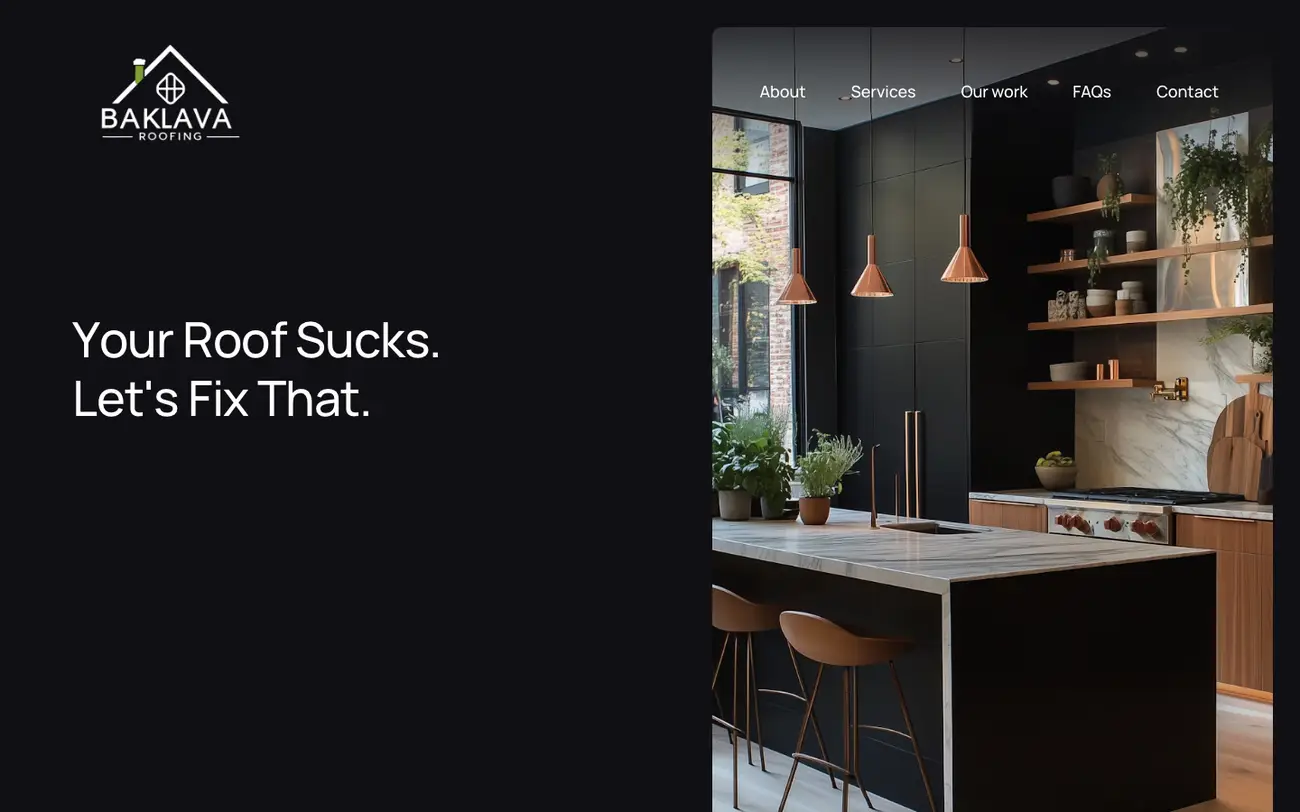
The website. A new site for the residential, commercial and solar lines, built around the same idea the brand is built on. Its headline is “your roof sucks. let’s fix that.” The site says the company answers. The systems behind it are what make that true rather than aspirational.
The trust signals and the blog engine. SEO for a young company is a different job than SEO for an established one, because there is no brand search to harvest and no backlink history to lean on. The programme was built on trust signals and a blog engine, which produced a steady climb in organic leads rather than a spike. Gradual is the correct shape for that curve at this stage, and a company that expects a spike usually quits before the climb starts paying.
The CRM. A custom CRM so nothing that calls in leaks out. Every call the agent takes and every chat the site handles lands in one place, attached to a job rather than scattered across a phone log, an inbox and somebody’s memory of a conversation in a truck.
The free-estimate funnel. A path from the first click to a booked estimate, so a visitor who is convinced at 3 AM can act at 3 AM instead of being asked to remember to call in the morning. Free estimates are table stakes in roofing. The difference is whether asking for one takes four steps and a phone call, or one form and a confirmation.
The brand video. A video produced for the company, doing the job a site cannot do on its own: showing that there are real people, real trucks and real work behind the name.
The deliverables
- A voice agent answering the phone at any hour, including through overnight storm calls
- A chat agent answering on the website in the same hours
- A new website covering the residential, commercial and solar lines
- SEO built on trust signals and a blog engine
- A custom CRM so nothing that calls in leaks out
- A free-estimate funnel running from first click to booked visit
- A brand video produced for the company
How it ran
- 2026Website, voice agent, chat agent, custom CRM and free-estimate funnel built and deployed across the residential, commercial and solar lines.
- 15 August 2026Both agents confirmed live, voice and chat. No public demo line published yet, so the phone is the client's own working number rather than a number to try.
The results
- 24/7
- Coverage on the phone and on the website chatMeasured August 2026
- 2
- Answering agents live on the account: one voice, one chatMeasured 15 August 2026
- 3
- Lines of work the company sells: residential, commercial, solarMeasured August 2026
What the numbers say
Baklava Roofing runs two answering agents, one on the phone and one in the website chat, both confirmed live on 15 August 2026. Between them they cover the phone and the chat window at every hour, across the three lines the company sells: residential roofing, commercial roofing and solar.
Baklava Roofing's SEO programme, built in 2026 on trust signals and a blog engine rather than on publishing volume, produced a steady climb in organic leads over the engagement.
The number that matters most to a roofer is jobs booked, and that number is not printed on this page. What is printed is what has been confirmed: the agents are deployed, the site is live, and the promise the brand makes is being kept at the hours it was most likely to break. A custom CRM was built to hold the leads, but no CRM record has been supplied, so nothing about what it currently holds is claimed here.
Why it worked
Because the promise came first and the technology was built to fit it, rather than the other way round.
Most companies pick a differentiator that sounds good in a brochure and cannot be checked. Baklava Roofing picked one a stranger can verify in thirty seconds, at three in the morning, from a phone. That is a strong position and a fragile one. It only survives if the mechanism behind it is real, which is why the phone and the chat window were treated as the product rather than as support functions.
The second reason is that nothing was left hanging between systems. A call answered at 3 AM that lives only in a call log is not a lead. It becomes a lead when it is written down, tagged, and sitting in front of somebody at seven the next morning with the address, the problem and the callback number already filled in. That is what the custom CRM and the free-estimate funnel do, and it is the least visible part of the build.
The third reason is subtraction of a kind. Nobody was added to payroll to make this work. A young company cannot carry a night receptionist, and the alternative it usually settles for is an answering service that takes a message and gets the details wrong. Neither of those was needed.
The takeaway
If you run a roofing company, the differentiator worth owning is response speed, because it is the one your competitors keep failing at and the one your customer can measure without knowing anything about roofs. Before you spend on ads, call your own number at eleven at night and see what happens. Then send a message through your own website contact form and time the reply.
Whatever that test tells you is what your marketing is actually promising, no matter what the homepage says. Fix the gap between the two before you buy more traffic, because every dollar spent driving people toward an unanswered phone is a dollar spent teaching them to call somebody else.
What's live right now
Questions people actually ask
Can I call the Baklava Roofing voice agent and hear it?
Not yet. There is no public demo line for this account. The agent answers the company's own working number, which is a live sales line for a live business, so it is not published here as something to test. The site we built is linked on this page and the chat agent on it answers in the same hours the voice agent does.
What happens to a 3 AM storm call when nobody at the company is awake?
It gets answered, the details get taken, and it lands in the CRM as a job rather than as a missed call in somebody's phone. That is the whole point of the build. A roofing emergency does not wait for business hours, and the homeowner making that call is usually working down a list of three roofers until one of them picks up.
Does an answering agent replace the office staff or work alongside them?
Alongside. It covers the hours nobody is at a desk and the moments when everyone is on a roof, which for a small crew is most of the working day. Quoting, inspecting and closing stay human. Catching the call and writing down who is calling and why does not need to be.
Does SEO work for a roofing company that nobody has heard of yet?
It works slower than it does for an established name, because there is no brand search to convert. Baklava Roofing's programme was built on trust signals and a blog engine rather than on volume, and it produced a steady climb in organic leads. A young company should expect that climb to be gradual and should not stop paying attention to it at week six.