Starr Law, P.C.
Sixteen people asked this firm for help in a single month
A North Texas criminal defence firm was invisible for the searches its own clients were typing. We rebuilt the foundation, and found something four previous agencies had missed.
- Industry
- Lawyers
- Location
- McKinney, TX
- Period
- March 2026 – July 2026
The challenge
Kent Starr has practised criminal law in Texas since 1997, out of an office in McKinney. He holds 448 five-star reviews, clerkships with the Arkansas and Navajo Nation Supreme Courts, a Golden Gloves boxing record, and nearly three decades of criminal trial work behind him.
None of that was reaching anybody. The reputation was already built. What was missing was any route between it and a person who had just been arrested and was searching for help on a phone at midnight.
That is a distribution problem, not a credibility problem, and the two get confused constantly. A firm with 448 reviews does not need to become more trustworthy. It needs the people already looking for exactly what it does to be able to find it.
What the audit found
Three ordinary problems, and one that stopped the audit cold.
The ordinary ones first. The website published a Plano address while the office was in McKinney, which quietly told search engines the firm served a city it did not sit in. Practice pages ran 85 words each, far too thin to be treated as an answer to any question worth ranking for. And every enquiry, from every source, landed in a single unfiltered inbox, so a felony matter arrived looking exactly like a vendor pitch.
Then the one that mattered. During the technical pass we found the site had been hacked, and was ranking first on Google for dark-web pornography terms. A poison pill, sitting on a criminal defence firm’s domain, indexed and live.
It had survived four previous agencies. That is not because they were careless. It is because nothing on the site looked wrong. The compromise lived in pages no visitor would ever navigate to, and no attorney has a reason to search for terms like those against their own domain. It surfaces in a crawl or it does not surface at all.
Everything else in the engagement waited until that was gone. There is no point earning rankings for a domain that is simultaneously ranking for something that would end a firm.
How we rebuilt it
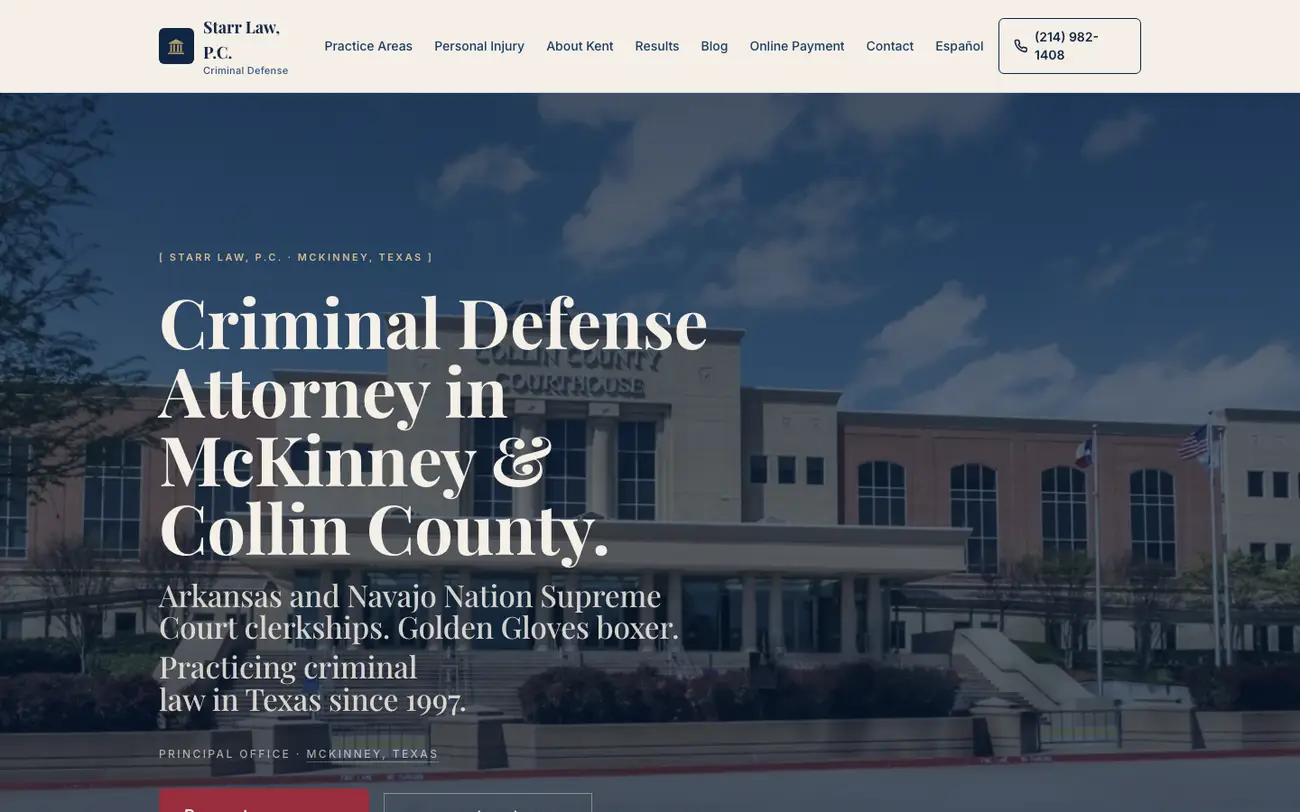
The cleanup and the foundation. 450+ technical corrections across the site. 44 pages removed outright, some for ranking harm and some because they carried Texas Bar advertising risk the firm should never have been holding. 21 more rewritten down to claims the firm could actually stand behind under scrutiny.
The practice pages. Taken from 85 words to 1,800. Not padded to a word count. A person searching “assault charge collin county” at one in the morning has a specific, frightened, concrete set of questions: what happens next, how bad is this, what does it cost, do I need somebody tonight. Eighty-five words cannot answer any of those. Eighteen hundred can answer all of them, which is the only reason the length is worth anything.
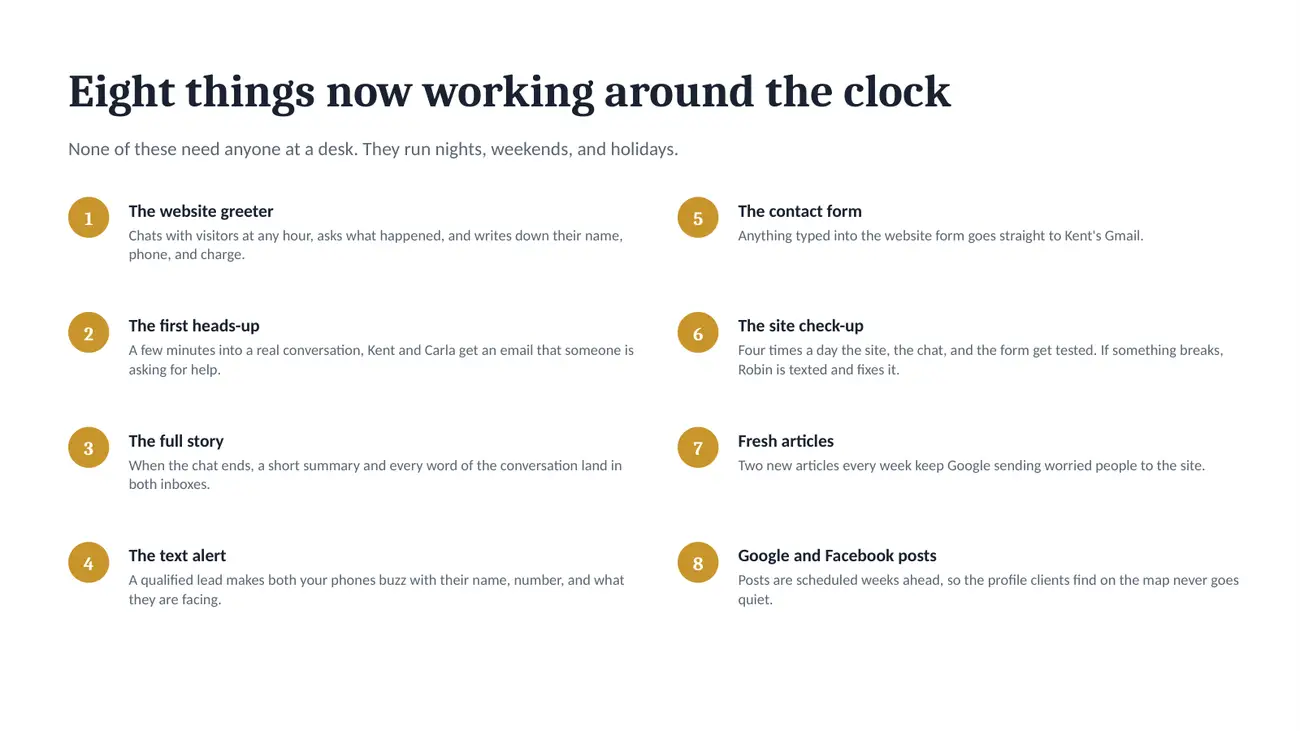
The intake system. A 24/7 assistant on the site, wired to send instant text alerts to two phones, with a health check running four times a day so a silent failure surfaces in hours rather than weeks. Every enquiry from every channel lands in one place, tagged, instead of in a shared inbox where urgency is invisible.
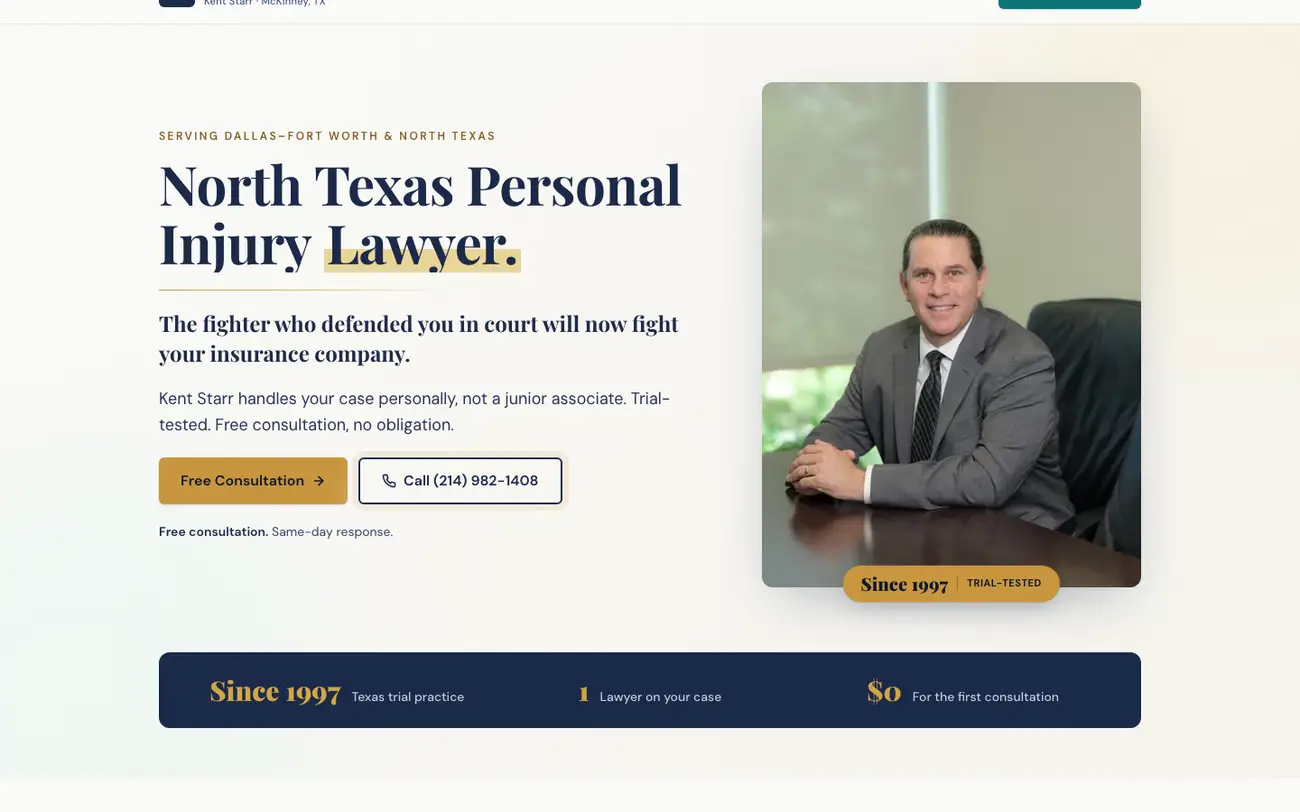
The photography. New photographs of the attorney, shot for the site and the advertising. For a regulated practice this is not decoration: Texas advertising rules mean real photographs of the actual attorney, and the alternative is stock imagery that reads as exactly what it is.
The second practice. A separate site for the personal injury side, built on the same reputation but deliberately kept apart from the criminal brand.
The deliverables
- 450+ technical corrections across the site
- 44 pages removed for ranking harm or Texas Bar advertising risk
- 21 pages rewritten to claims the firm can stand behind
- Practice pages taken from 85 words to 1,800
- 24/7 intake assistant with instant text alerts to two phones and a four-times-daily health check
- New photography shot for the site and the advertising
- A second practice site for the personal injury side of the firm
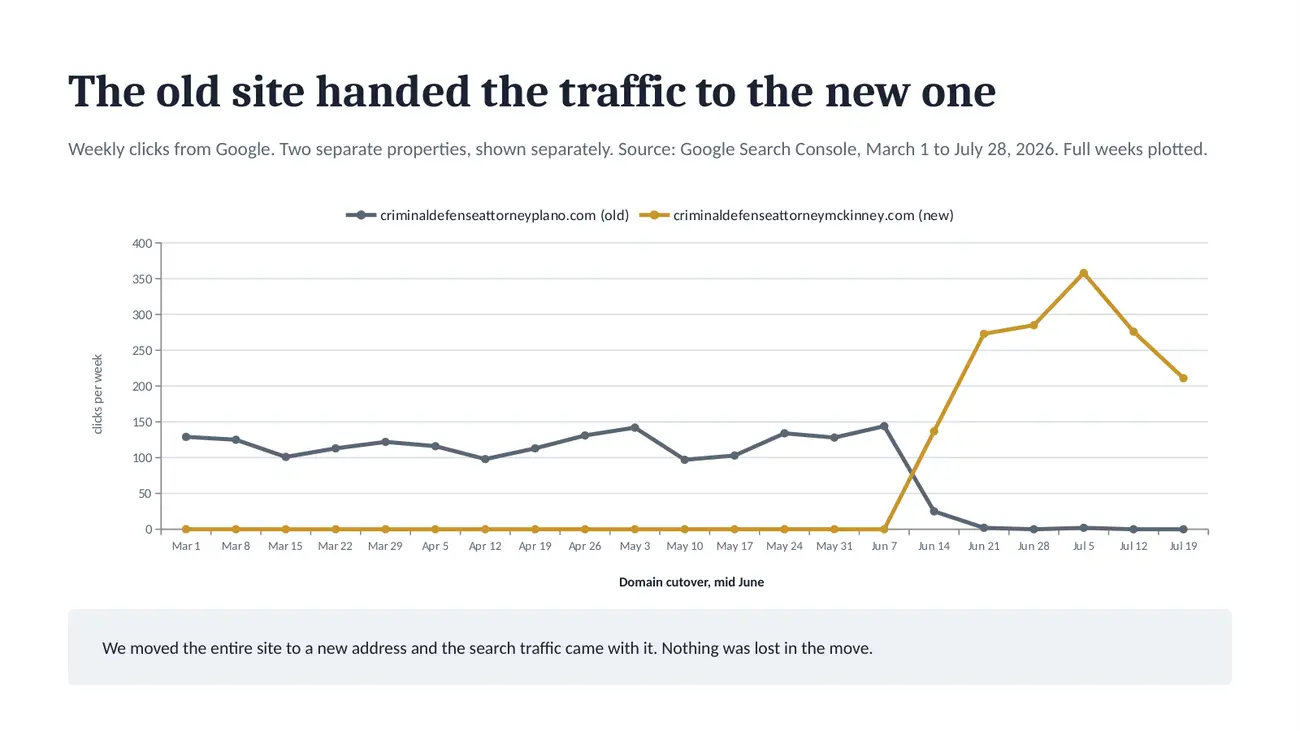





How it ran
- March 2026Audit opens. The site carries a Plano address while the office is in McKinney, the practice pages run 85 words each, and every enquiry lands in one unfiltered inbox.
- April 2026The forensic pass finds the site has been hacked and is ranking first on Google for dark-web pornography terms. Cleanup starts before anything else does.
- May 2026Rebuild ships. 450+ corrections, 44 pages removed, 21 rewritten, practice pages taken to 1,800 words, intake assistant live.
- July 202694,500 impressions and 1,052 clicks in four weeks. Sixteen inquiries, opened and counted by hand.
The results
- $75K
- Value of a single lead the firm attributed to the rebuilt lead pathMeasured September 2026
- 16
- Real inquiries, July 2026, counted by handMeasured July 2026
- 94,500
- Google impressions in four weeksMeasured July 2026
- 13th → 8th
- Average position on the core search termMeasured July 2026
- 1,052
- Clicks, 2-29 July 2026Measured 29 July 2026
- 450+
- Technical corrections shipped in the rebuildMeasured July 2026
What the numbers say
Sixteen real people asked Starr Law for help in July 2026, every one arriving from organic search. That number was produced by opening and reading each enquiry by hand, not by reading a dashboard, which is why it is sixteen and not a rounder, larger, less useful figure.
Underneath it: 94,500 Google impressions across four weeks, 1,052 clicks between 2 and 29 July, and the core search term moving from 13th to 8th.
The search terms themselves are the part worth reading twice. The single biggest driver was "criminal defense attorney mckinney" at 19 clicks — people who did not know the firm existed and were describing their problem and their city. Behind it, "kent starr attorney" at 16 and "kent starr" at 15: people who already had the name, from a referral or a court hallway, and were checking he was real.
Both groups now land somewhere that answers them. Before this, the second group found the firm and the first group did not.
Why it worked
Because the sequence was right, not because any single piece was clever.
The compromise came off first. Then the foundation. Then the content that could rank on that foundation. Then the intake to catch what the content brought in. Reversed in any order, the work would have been wasted — content published onto a poisoned domain, or an intake assistant sitting on a site nobody could find.
The other reason is subtraction. Forty-four pages were deleted and twenty-one rewritten smaller and truer. Most of the visible work in this engagement was removal, and the number that came out the far end was produced by the removal as much as by anything added.
The takeaway
If you run a firm with a real reputation and no inbound, the problem is almost never that you need to look more credible. Check the foundation before buying more content: crawl your own domain, look at what it actually ranks for rather than what you hope it ranks for, and read your practice pages as though you had just been arrested at 2am.
And count your leads by hand for one month. Every dashboard on the market will show you a number. Sixteen people whose enquiries you have personally opened will tell you something a dashboard cannot, which is whether the number is real.
What's live right now
Questions people actually ask
How long does SEO take for a criminal defence firm?
This engagement ran March to July 2026. The rebuild shipped in May, and July was the first full month measured from a clean foundation: 94,500 impressions and 1,052 clicks. Four to five months is realistic when the site is starting from damage rather than from zero, because the damage has to come off before anything can be built on top of it.
What does a hacked law firm website actually look like?
Usually, nothing. Every page a lawyer would check looks normal. In this case the compromise surfaced only in a technical crawl, where the site was found ranking first on Google for dark-web pornography terms. Nobody at the firm had any reason to search for those, so the problem had sat there through four previous agencies.
Does a 24/7 intake assistant actually work for a law firm?
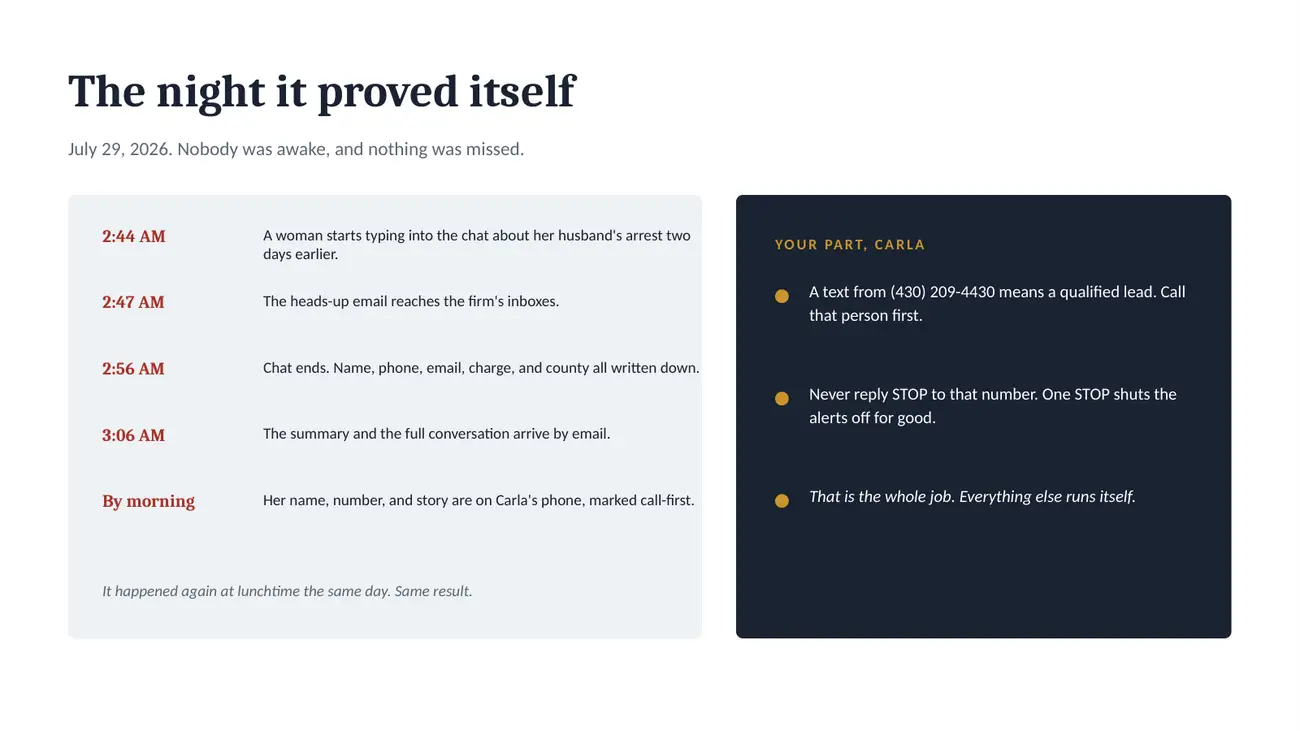
At 2:44 in the morning on 29 July 2026, a woman started typing about her husband's arrest. The firm was notified at 2:47. By 2:56 her name, number, email, the charge and the county were written down, and at 3:06 the full conversation was in two inboxes. It happened again at lunchtime the same day. Neither of those two would have left a voicemail.
How much of this was the website and how much was the intake?
They do different jobs and neither works alone. The rebuild is what got the firm in front of people searching. The intake is what stopped those people from bouncing at two in the morning. A site that ranks and cannot answer produces impressions; an assistant on a site nobody finds answers nothing.