ECX Energy
First place in their own sales competition, won with one file
A commercial energy brokerage was losing its selling week to prospect research, follow-up emails and the same three objections. We built one file that handles all three, and the rep running it finished first in the competition ECX was holding internally.
- Industry
- Energy
The challenge
ECX Energy is a commercial energy brokerage working across the United States. Its business development reps sell by phone, to buyers who did not plan on taking the call.
Nothing about the team was broken. The reps could sell. What they could not do was get to the selling quickly enough, because three pieces of unpaid work sat in front of every conversation and behind every one that went well.
Research came first. Before a rep could dial with anything worth saying, somebody had to work out who the company was, what its energy was likely costing it, what would make that uncomfortable, and who inside the building could sign. That was a morning’s work. A morning is most of a selling day.
Follow-ups came afterwards. Every one of those emails was written from scratch, one at a time, every day.
Objections sat in the middle. The same three came up on call after call, and they were answered differently every time, because nothing was written down. A rep who has already beaten an objection twelve times will still improvise the thirteenth, if nobody ever wrote down what worked on the twelfth.
None of that is a talent problem, and no amount of coaching fixes it. It is a repetition problem. Repetition is the one thing a person is worst at and a tool is best at, and the gap between those two is where a sales week quietly disappears.
What the audit found
We looked at the week rather than at the pipeline. Three things came out of it, and they turned out to be the same thing wearing different clothes.
Follow-up emails were being written from scratch, one at a time, every day. Not started from a template and adjusted. Started from nothing, each time, for every prospect who had already had a real conversation and therefore deserved a real reply. This is the most expensive kind of work in a sales day, because it looks like progress while producing none.
The same three objections were killing calls, and each one was answered differently every time. Three. Not thirty. A team that knows exactly which three sentences end its calls, and still meets them cold every time, is not short of skill. It is short of a written record.
Prospect research was being done by hand before every call. A morning of it, before a single dial. This was the finding that mattered most, because it sits upstream of everything else. Research that takes a morning does not only cost the morning. It sets a ceiling on how many conversations can happen at all, and it makes every uncertain prospect look too expensive to bother calling, which is how a pipeline narrows without anybody deciding to narrow it.
The shared shape underneath all three is that the rep was regenerating something that had already existed. The research had been done before, for a company in the same category. The follow-up had been written before, in almost the same words. The rebuttal had worked before, on a Tuesday, and then evaporated because nobody kept it.
So the build had nothing to do with making anybody sell harder. It had to catch the work that was already being produced and stop it being thrown away every evening.
How we rebuilt it
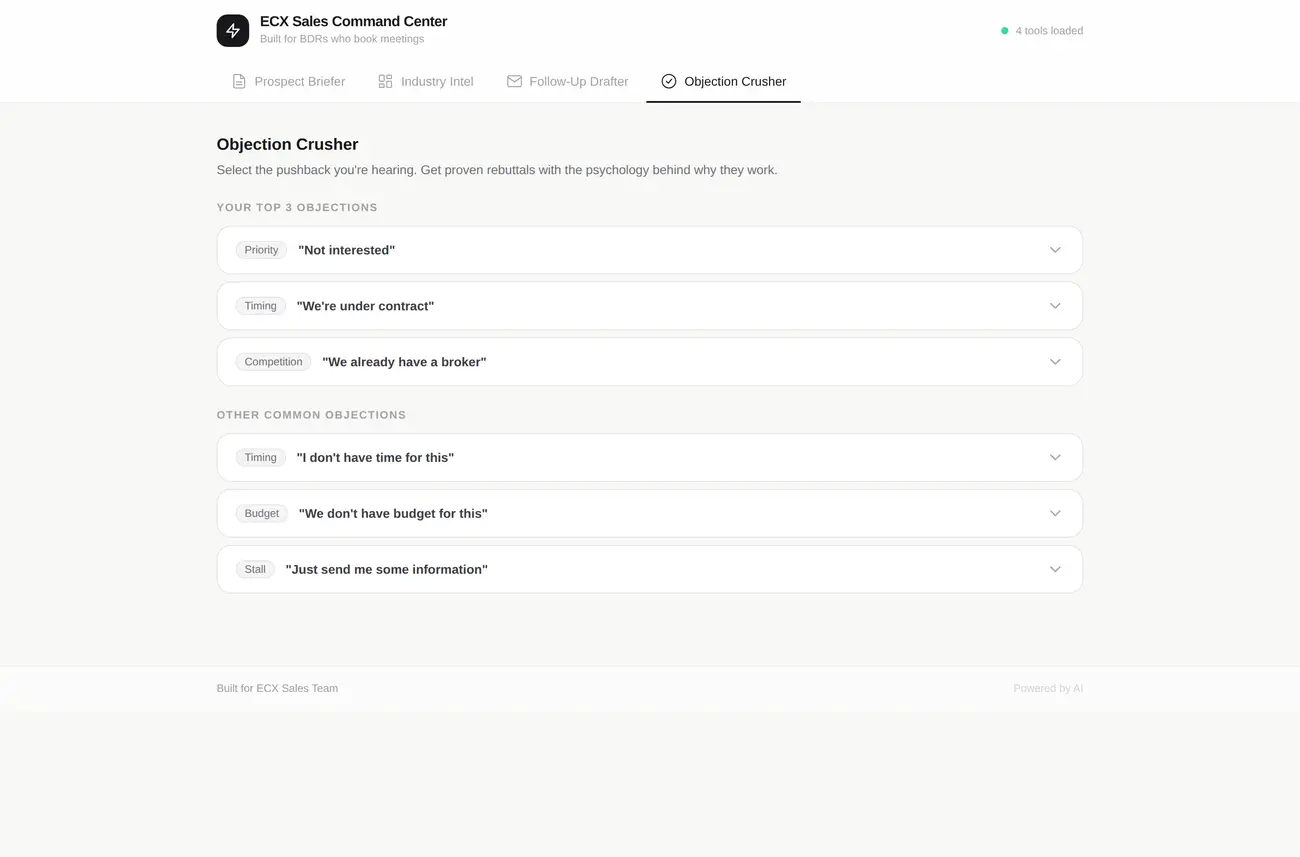
The tool we delivered to ECX Energy in 2026 is one self-contained file with four tabs: prospect briefings, a pain-point engine, a follow-up drafter and an objection handler. One tab for each job that was eating the week.
The prospect briefing generator. A company name goes in and a complete pre-call brief comes out: a cold open written for that specific company, a voicemail script for the far more likely case where nobody picks up, and that prospect’s pain points ranked in order. The ranking is the part that does the work. An unranked list of six things a prospect might care about is another decision handed to the rep thirty seconds before a dial, and a decision at that moment is a pause.
The pain-point engine. The layer underneath the briefing, holding what actually goes wrong for a commercial energy buyer and which of those problems is worth opening on for this particular company. It is what lets a brief say something specific rather than something true of everyone.
The follow-up drafter. It writes the follow-up in the rep’s own voice, ready to send. That constraint drove the whole tab. Anything that comes out sounding like software has to be rewritten, and rewriting takes longer than writing, so the test we built against was whether she would send the draft without touching it.
The objection handler. Proven rebuttals for the top three call killers, each one carried with the reasoning behind why it works. The reasoning matters more than the script. A rep who only has the words will read them flat the first time an objection arrives in a slightly different shape. A rep who knows why the answer lands can rebuild it live, and will still be using it in month six.
One self-contained file. Nothing to install, nothing to configure, nobody to administer. That was a deliberate ceiling rather than a shortcut. A single rep does not need seats, permissions, an onboarding session or a rollout plan, and every one of those things is a reason a sales tool goes unopened by week three.
It was delivered with no contract in place. The argument for a build like this is easier to make with the thing already working than with a proposal describing it. What happened after that is a matter of record inside ECX Energy’s own competition.
The deliverables
- A four-tab sales tool: prospect briefings, pain-point engine, follow-up drafter, objection handler
- A briefing generator that takes a company name in and returns a complete pre-call brief
- A cold open and a voicemail script written per prospect, with that prospect's pain points ranked
- A follow-up drafter that writes the email in the rep's own voice, ready to send
- A rebuttal library for the top three objections, carrying the reasoning behind why each one lands
- Cold-call and email scripts built from what already works on the phone, not from theory
- One self-contained file, delivered with no contract in place
The results
- 1st
- Place in the internal sales competition ECX Energy was runningMeasured 2026
- 4
- Tabs in the tool, one for each job that was eating the weekMeasured 2026
- 3
- Objections the response library answers, with the reasoning behind eachMeasured 2026
- 1
- Files the whole thing ships asMeasured 2026
What the numbers say
ECX Energy ran an internal sales competition in 2026, and the business development rep using the tool we built for the brokerage finished it in first place. That placement is the brokerage's own count, scored inside its own competition, against its own reps.
Underneath the placement, the shape of the build is four tabs, three objections and one file. Four tabs because four separate jobs were eating the week: prospect briefings, a pain-point engine, a follow-up drafter and an objection handler. Three objections because three were what the calls actually kept dying on, and a library of thirty would have gone unread. One file because a second file is a second thing to remember on a day that already has enough of them.
The number worth holding on to is not really any of those. It is the morning. Prospect research at ECX Energy took a morning before the build, and afterwards it happened before the first dial. A selling day that opens with a morning of research is not a selling day, it is an afternoon.
Why it worked
Because it removed decisions, not steps.
Sales tools usually try to remove steps, and reps route around them, because the step was never the expensive part. The expensive part is starting from a blank page while holding three open questions at once: how to open, what this particular company probably cares about, and what to say when they push back for the third time this week. Each of those is a decision made cold, in the ninety seconds before a dial.
The tool answers all three before the phone is picked up. The rep still dials, still reads the room, still closes. What she no longer does is invent the opening from nothing.
The second reason is the voice. A drafter that writes in a generic corporate register produces text a rep has to rewrite, and rewriting takes longer than writing, so a drafter that writes well but writes like somebody else is worse than nothing. Because the drafts come out in her own voice, sending is the default action rather than the last step in an editing job. That is the difference between a tool still in use in month three and one quietly abandoned in week two.
The third reason is subtraction. There is one file. Everything a sales tool usually grows around the useful part is the reason the useful part goes unused, and none of it got built here.
The takeaway
If you run a sales team, spend one week timing what happens before the calls rather than measuring the calls. Count the minutes going to research, to writing follow-ups from scratch, and to improvising an answer to an objection the team has already beaten a hundred times. Those three usually account for more of the week than anyone on the team believes, and none of them are selling.
Then write down the three objections that kill your calls, and the answers that have actually worked on the phone, in the words the rep used when they worked. That document costs nothing, can be finished this week, and is worth more than most sales software. Everything we built for ECX Energy is that idea with the manual labour taken out of it.
The same subtract-first approach to sales tooling applies just as directly to [cybersecurity companies](/work/cybersecurity/) and [marketing agencies](/work/marketing-agencies/) selling technical services on the phone.
Questions people actually ask
What does a custom sales tool actually do before a cold call?
In ECX Energy's case it produces the brief. A rep puts in the company, and the tool returns a cold open written for that company, a voicemail script for the times nobody picks up, and that prospect's pain points in ranked order. It replaces the manual research that used to take a morning. That research now happens before the first dial.
Is this a replacement for the CRM a sales team already uses?
No. What we delivered to ECX Energy has four tabs and all four of them are about the next conversation: the briefing, the pain points, the follow-up draft and the objection answers. It does not hold the pipeline, the records or the reporting, and it was never meant to. Whatever the team already runs its deals in keeps running them.
Does something like this work for a sales team of one?
The ECX Energy tool was built for one business development rep, and that is the whole reason it took the shape it did. One person does not need seats, permissions or a rollout plan, so none of that got built. What she needed was follow-up drafts that sounded like her rather than like a template, which is easier to deliver for one voice than for twelve.
What happens to the scripts and rebuttals the team already has?
They become the source material. The response library we built for ECX Energy was assembled from what already worked on the phone, not from a generic sales playbook. The three objections in it are the three that were actually killing that team's calls. A library written from theory produces answers the rep does not believe, and a rep who does not believe the answer does not use it twice.