MVP Truck Parts
820 reviews earned, and not one of them on a product page
A heavy-duty truck parts distributor outside Chicago already ranked first for dozens of part numbers and bought no advertising at all. We rebuilt their best-selling product page before they hired us.
- Industry
- Trucking + auto parts
- Location
- Elk Grove Village, IL
- Period
- June 2026 – August 2026
The challenge
MVP Truck Parts sells heavy-duty truck parts out of Elk Grove Village, Illinois. The customer is a fleet manager or an owner-operator with a truck standing still, and a truck that is not moving is a bill running. That shapes the whole demand: urgent, specific, and searched by part number rather than by category.
They were already winning the hard part. 1,587 parts in the catalogue. 667 Google reviews at 4.8 stars when the engagement opened in June 2026. First position on Google for dozens of part-number searches. 5.5K organic clicks a month, with no advertising spend behind any of them.
What was missing was everything downstream of the click.
The reviews sat on a profile page a buyer only reaches by going to look for it. The rankings delivered people onto product pages that named a part, priced it, and stopped there. And no campaign was running in any channel, while two national competitors bought the category terms every day.
That is the opposite of the usual problem. Most businesses need to be found. MVP Truck Parts was already being found, several thousand times a month, for free. What it needed was for the finding to turn into an order.
What the audit found
Three things sitting in plain sight, and one report nobody had ever run.
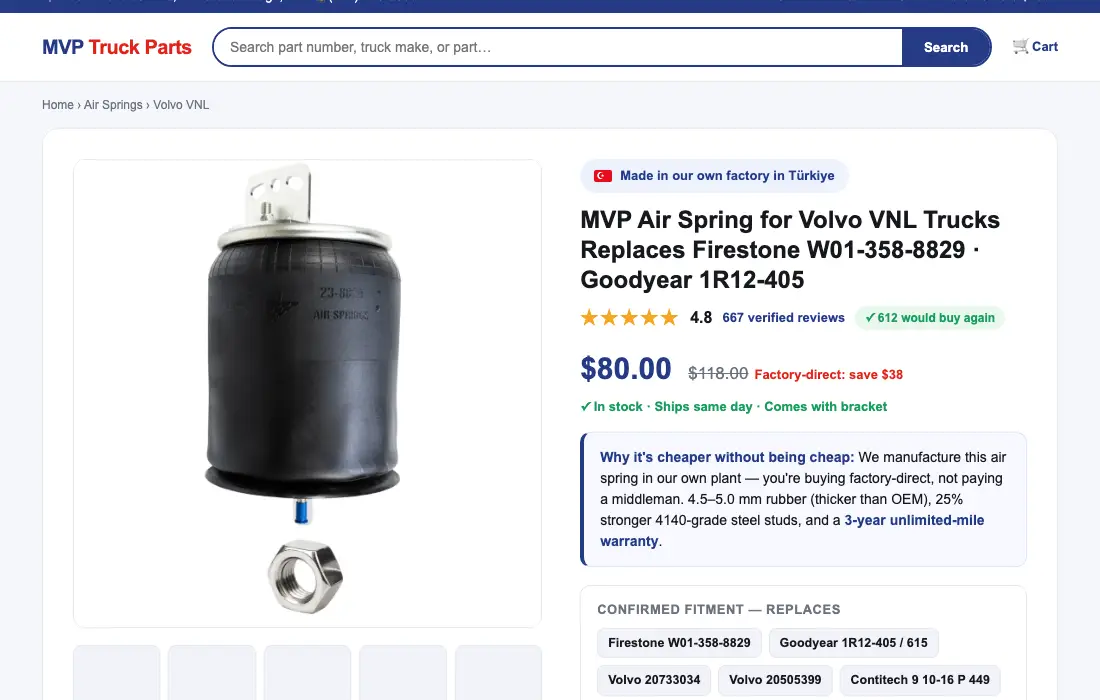
820 reviews earned, showing on zero product pages. By 14 August 2026 the count had reached 820 at a 4.8 rating. Every one of them came from shipping the right part on time. None of them appeared at the moment a buyer hesitates, which is the product page, with the part in the cart and a competitor’s tab open beside it. Trust a company has already earned and does not display is the cheapest asset in the business, and this one was sitting unspent.
Zero paid campaigns, against two competitors buying daily. Semrush confirmed it on 5 August 2026: paid traffic, zero. There is nothing wrong with that on its own. The problem is the shape of the gap. Organic strength here is concentrated on part numbers, which is what a buyer types when they already know exactly what broke and only need somewhere to buy it. The category terms, typed by the buyer who has not diagnosed the fault yet and is still choosing a supplier, were being bought every day by two national competitors and contested by nobody.
First position on dozens of part-number searches, with nothing built to use it. Ranking first is a starting position, not an outcome. It puts a buyer on a page, and what that page does next decides whether the ranking was worth anything at all.
The pages those searches landed on were built to list a part, not to close one.
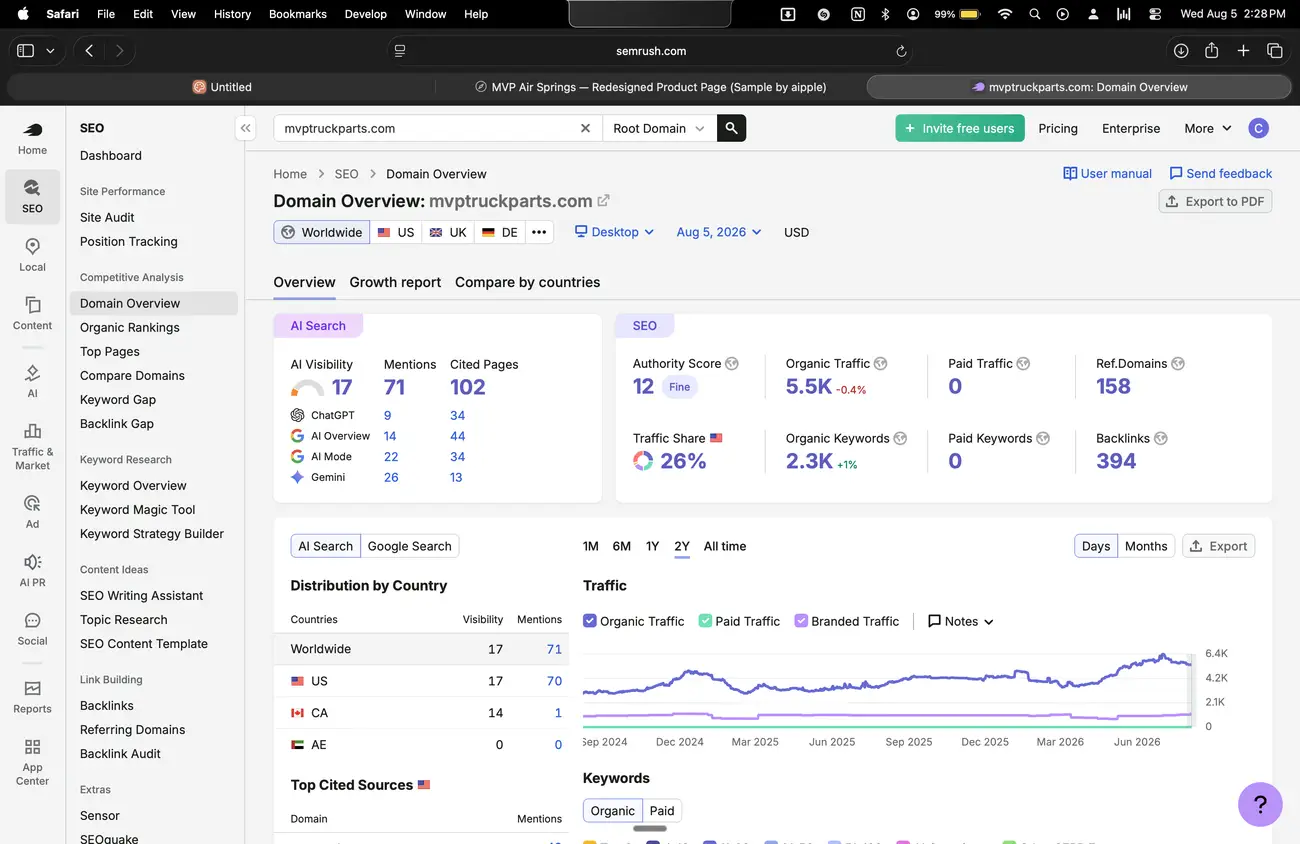
Then the report nobody had run. On 5 August 2026, Semrush AI Search returned an AI visibility score of 17 for MVP Truck Parts, built from 71 mentions across 102 cited pages, over four engines: ChatGPT, Google AI Overview, AI Mode and Gemini. Nobody at the company had been shown that report, because almost nobody in the trade is showing it to anybody yet. A buyer asking an assistant which supplier stocks a part never reaches a results page, and that was already happening at that volume by August 2026.
How we rebuilt it
The product page, built before the contract. The first thing we built for MVP Truck Parts, we built before they hired us. No contract, no retainer, no invoice: their best-selling product page, rebuilt and handed over, with the 4.8 rating and the review count carried up to the point where the buying decision actually happens. It is a fair way to open a conversation with a distributor who has heard a lot of pitches, and it is a faster way to test a diagnosis than any proposal document. If putting the reviews on the page was the wrong call, that shows up quickly and costs the client nothing.
The stock-check agent. A WhatsApp agent running against a knowledge base built over their own inventory. A customer messages asking whether a part is in stock, and the answer comes back with availability, price and pickup. No hold music, no callback, nobody pulled off the counter to look at a shelf. This works better for parts than for most categories because the question is nearly always the same question, and the honest answer to it is a lookup rather than a judgement call, which is exactly the kind of work that should not require a person.
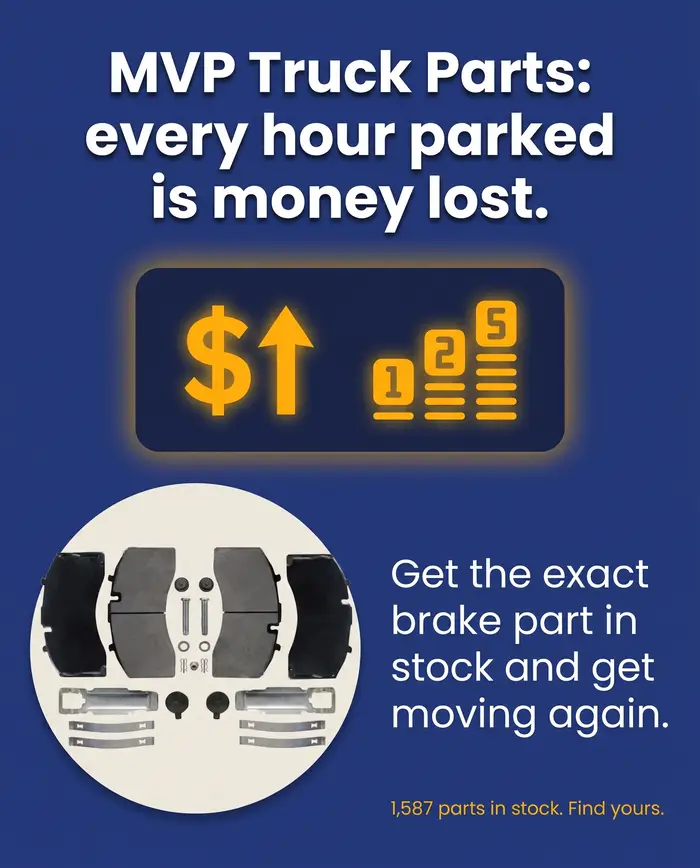
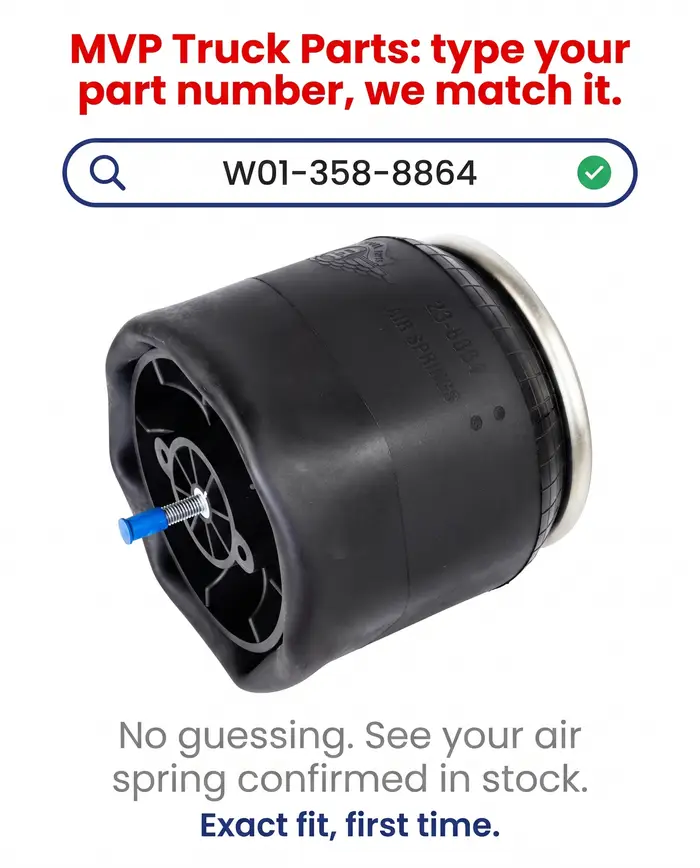
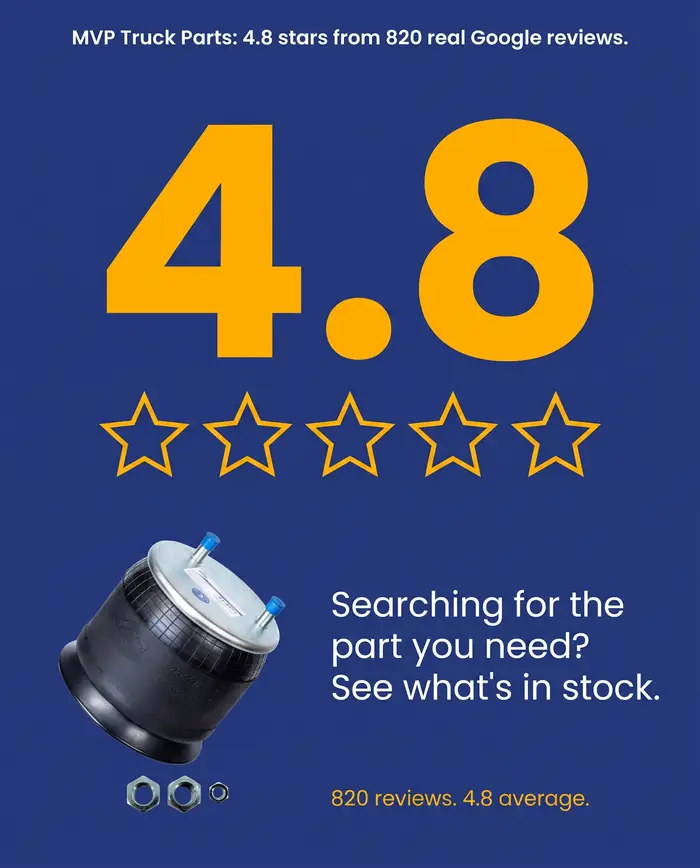
The campaigns and the creative. Meta and Google campaigns built to contest the category terms that organic rankings structurally cannot reach. Eight creatives were produced on 14 August 2026, across six buyer personas, eight angles and eight formats with no repeats, and none of them are running yet. Every figure in them was traced to a dated source before spend was considered, and that check held two of them back. The warranty claim is scoped to air springs only, because that is what the source supports. The creative carrying the 4.8-star headline renders five hollow stars underneath the number and gets filled before it goes live. Two social videos were produced for their channels in the same period.
The AI-search tracking. The visibility report is now pulled as a standing measurement rather than a one-off curiosity, across all four engines. It is the only channel on this account where the competitive field is still effectively empty, and the only way to know whether that changes is to have been measuring it before it does.
The deliverables
- Best-selling product page rebuilt on spec, before any contract existed
- Rating and review count carried onto the page where the buying decision happens
- WhatsApp stock-check agent answering availability, price and pickup from their own inventory
- Meta and Google campaigns built for the category terms two national competitors were buying daily
- Eight ad creatives across six buyer personas, eight angles, eight formats, no repeats
- Two social videos produced for their channels
- AI-search visibility tracked across ChatGPT, Google AI Overview, AI Mode and Gemini
How it ran
- Before the contractThe best-selling product page is rebuilt on spec and handed over. No contract, no retainer, no invoice.
- June 2026Engagement opens. 667 Google reviews earned, appearing on no product page. No paid campaign running in any channel.
- 5 August 2026Semrush pull: 5.5K organic clicks a month, zero paid campaigns, 1,587 parts in the catalogue. AI search returns 71 mentions across 102 cited pages and four engines.
- 14 August 2026Google Business Profile returns 820 reviews at 4.8. Eight ad creatives are produced the same day and held back from spend until the corrections land.
The results
- 667 → 820
- Google reviews at 4.8 starsMeasured 14 August 2026
- 5.5K
- Organic clicks a monthMeasured 5 August 2026
- 0
- Paid campaigns running while those clicks arrivedMeasured 5 August 2026
- 1,587
- Parts in the catalogueMeasured 5 August 2026
- 71
- Mentions in AI search across four enginesMeasured 5 August 2026
- 102
- Pages citing MVP Truck Parts in AI searchMeasured 5 August 2026
- 17
- AI visibility score, Semrush AI SearchMeasured 5 August 2026
What the numbers say
MVP Truck Parts went from 667 Google reviews to 820 at a 4.8 rating between June and August 2026. That is 153 more reviews in under three months, each one from somebody who went back to the internet on purpose to say the part arrived right. Nothing an agency writes outranks that, which is why the first structural change was showing it on the page where the money moves rather than on a profile most buyers never open.
MVP Truck Parts records 5.5K organic clicks a month with no paid campaigns running, measured 5 August 2026. Both halves of that sentence matter. The first half says the demand is real and already arriving. The second half says every one of those clicks was free, and that the paid channel is not underperforming, it is empty.
Underneath both: 1,587 parts in the catalogue, and first position on dozens of part-number searches. Depth of catalogue is what makes the part-number rankings possible in the first place. A distributor with 200 lines cannot rank for a thousand part numbers, because it does not sell a thousand parts.
Then the report nobody had run. On 5 August 2026, Semrush AI Search gave MVP Truck Parts an AI visibility score of 17, built from 71 mentions across 102 cited pages, over ChatGPT, Google AI Overview, AI Mode and Gemini. A buyer asking an assistant which supplier stocks a part is a search that never reaches a results page, and it was already running at that volume in August 2026.
The same measurement discipline runs across every industry aipple serves, including [accounting firms](/work/accounting/) and [cybersecurity companies](/work/cybersecurity/): no number ships without a dated source behind it.
Why it worked
Because the work was addition to something already working, not repair of something broken.
The usual sequence on an engagement like this is to fix the foundation, earn the rankings, then build the conversion layer on top. MVP Truck Parts had done the first two themselves and stopped. The catalogue was deep, the reviews were real, the rankings were live, and the clicks were arriving. Every hour spent rebuilding any of that would have been an hour spent on a problem the company did not have.
So the work went to the joints. Reviews to the product page. A stock-check answer to the question that was already being asked. Paid campaigns to the searches that organic rankings structurally cannot reach. Each of those is small on its own, and each one connects an asset that already existed to a moment where it was missing.
The other reason is that nothing shipped on an unchecked number. Eight creatives were produced on 14 August 2026, and two of them came back from that check needing a correction before any of the eight could run. A distributor earns 820 reviews by being right about parts. An advertiser who is loose about a warranty spends that down faster than any campaign builds it.
The takeaway
If you run a distribution business with strong search rankings and no advertising, do not start by buying traffic. Start by opening your own best-selling product page on a phone and asking what a first-time buyer would need to see there to choose you over a national competitor with a cheaper price and a slower ship time. Your rating and your review count almost certainly belong on that page and almost certainly are not.
Then pull your AI-search report. Whatever the number is, you have never seen it, your competitors have not seen theirs either, and a buyer asking an assistant for a supplier is already a search you are either winning or losing without knowing which.
What's live right now
Questions people actually ask
What does a WhatsApp stock-check agent actually do for a parts distributor?
A customer messages to ask whether a part is in stock. The agent checks a knowledge base built over MVP Truck Parts' own inventory and answers with availability, price and pickup. No hold music, no callback, nobody pulled off the counter. It works for parts because the question is nearly always the same question, and the honest answer is a lookup rather than a judgement call.
Why would a distributor with 5.5K organic clicks a month need paid advertising?
Because organic strength and paid demand sit on different searches. MVP Truck Parts ranks first for dozens of part-number searches, which is what a buyer types when they already know exactly what broke. The category terms, typed by someone still choosing a supplier, were being bought daily by two national competitors and contested by nobody. Ranking first for the second half of the decision does not put you in front of the first half.
Does AI search visibility matter when you sell truck parts?
On 5 August 2026, Semrush AI Search recorded 71 mentions of MVP Truck Parts across 102 cited pages and four engines: ChatGPT, Google AI Overview, AI Mode and Gemini. That is a real volume of buyers getting an answer about a supplier without ever opening a browser tab. Most distributors have never seen this report for their own domain, which is exactly why it is worth pulling.
The ad creative is finished. Why is none of it running?
Eight creatives were produced on 14 August 2026 and every figure in them was traced back to a dated source before anything went to spend. Two corrections came out of that check. The warranty claim is scoped to air springs only, because that is what the source supports and nothing wider. The creative carrying the 4.8-star headline renders five hollow stars underneath it and gets filled before it runs. A parts buyer who catches an overstated warranty in an ad does not come back to check the rest of the catalogue.