Exotic Snaxx
A candy shop with no website now sells 2,500 products online
Exotic Snaxx had a 4.9 rating from 122 Google reviews and no way for anyone outside Harlem Irving Plaza to buy a thing. We built the storefront, the catalogue and the channels from nothing.
- Industry
- Retail + ecommerce
- Location
- Harwood Heights, IL
The challenge
Exotic Snaxx sells rare imports out of a unit in Harlem Irving Plaza in Harwood Heights, Illinois: candy, drinks and snacks that do not turn up on an American grocery shelf.
The shop worked. It had collected 122 Google reviews at a 4.9 rating, which is a real reputation for a mall unit, and it had built that rating with no marketing of any kind.
Every one of those 122 customers found the shop the same way. They walked past the door.
That sentence is the entire business, and it is also the ceiling on it. A store that can only sell to people already standing inside a shopping centre is capped at whatever the shopping centre delivers that week. Exotic Snaxx had no website, no online store and no search presence.
Somebody in the next suburb hunting a specific Japanese soda, a Filipinocandy, or the noodle that went around TikTok on Tuesday had no way of learning the shop existed, and no way to buy from it if they did.
The reputation was real and the demand was real. Neither one had anywhere to land.
What the audit found
The usual finding in retail is that the marketing is weak. Here there was nothing to market against.
Not a thin site. Not an outdated site. No digital surface at all. That changes the order of the work, because every tactic a shop would normally reach for, paid ads, email, social, local search, is a way of sending a person somewhere, and there was no somewhere.
The second finding was the reputation sitting idle. 122 reviews at 4.9 is the kind of trust signal a new online store spends a long time earning, and it was doing nothing outside the mall corridor. A rating cannot be indexed, linked to, or shopped. It only starts paying once a buyer has a page to arrive on.
The third finding was the catalogue, and that turned out to be the hard part. Two and a half thousand products, most of them unfamiliar to the shopper by name. Nobody walks into a rare imports store searching for a product code. They arrive holding one of four completely different intentions: they want a category, they want a country they grew up in or want to try, they want the exact item they saw on their phone last night, or they want to know how badly something is going to hurt. One category tree serves the first of those and fails the other three.
How we rebuilt it
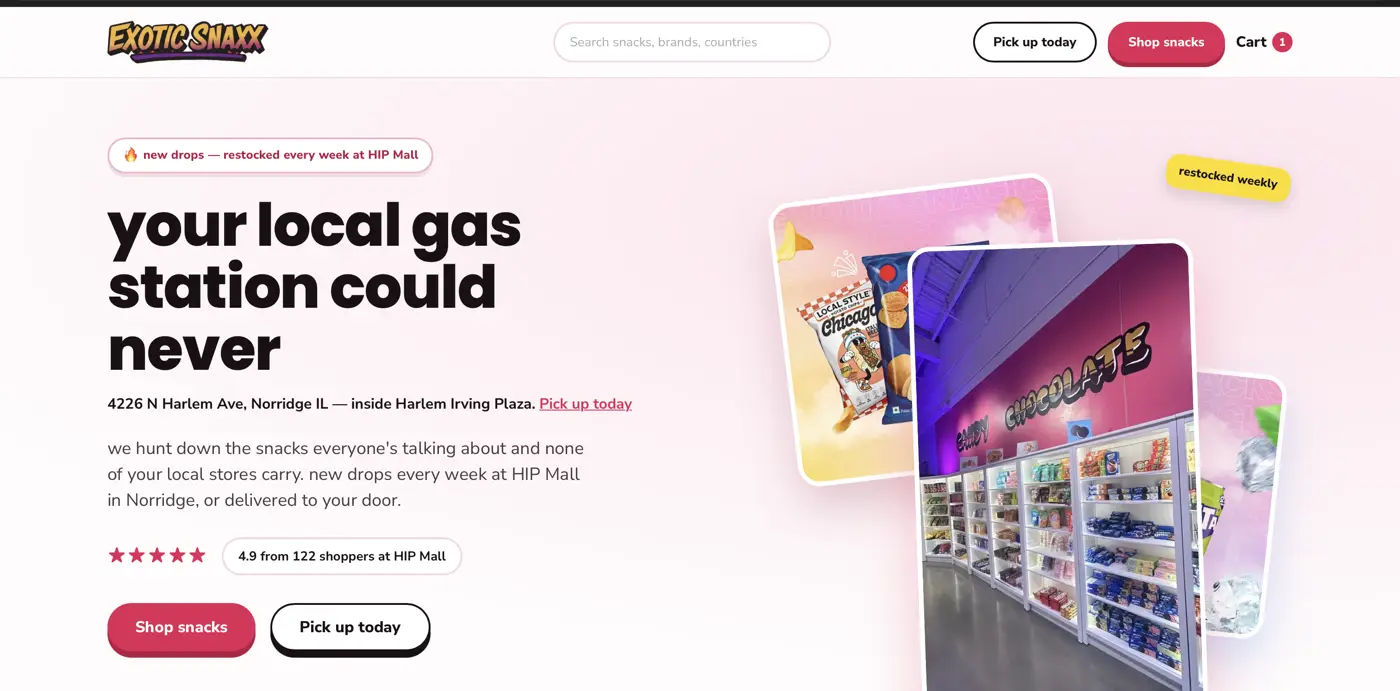
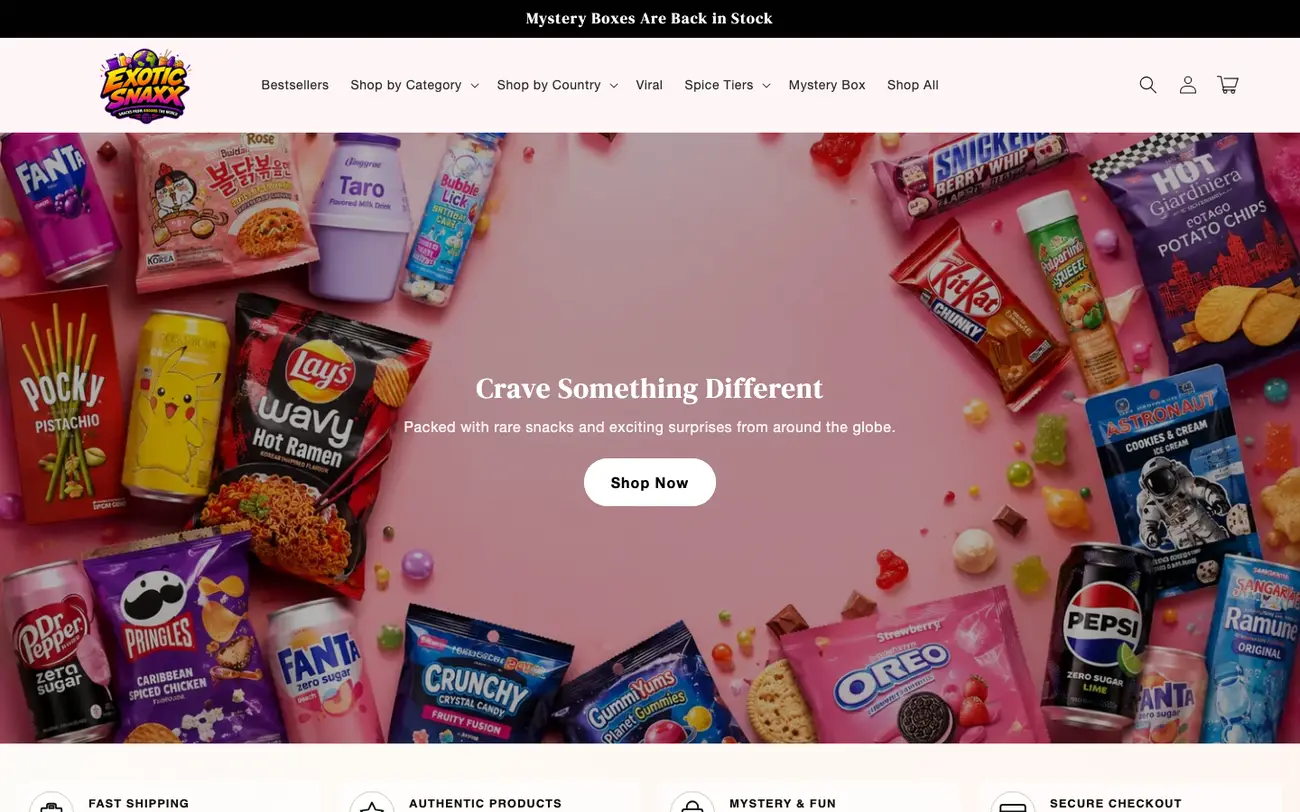
The storefront. A Shopify store at exoticsnaxxshop.com with 2,500 products live, for a business that had never had a web page. The scale is the point more than the platform is. A rare imports shop is a long-tail business: no single product carries the store, and the value sits in the depth, so a storefront listing only the obvious sellers throws away the exact thing that makes the shop worth a drive.
Four ways in. Browse by category, by country, by viral item, and by spice tier. Each one is a different buyer. Category is the shopper who already knows they want drinks. Country is the customer looking for the sweets they grew up with. Viral item is the person who saw something at midnight and cannot name it. Spice tier is the buyer who wants the challenge or wants to avoid it, and that is a judgement the counter staff used to make in person and the page now has to make for them.
Collect at the mall. Checkout lets a customer buy online and pick the order up at the Harlem Irving Plaza store. It takes shipping cost and shipping time out of the decision for anyone nearby, and it walks a person who would otherwise have stayed home into a shop full of things they did not order.
The content layer. SEO and blog content published against the catalogue, so the store carries something a search engine can read besides product pages. A new domain holding 2,500 products and no written content is a warehouse nobody has a reason to link to.
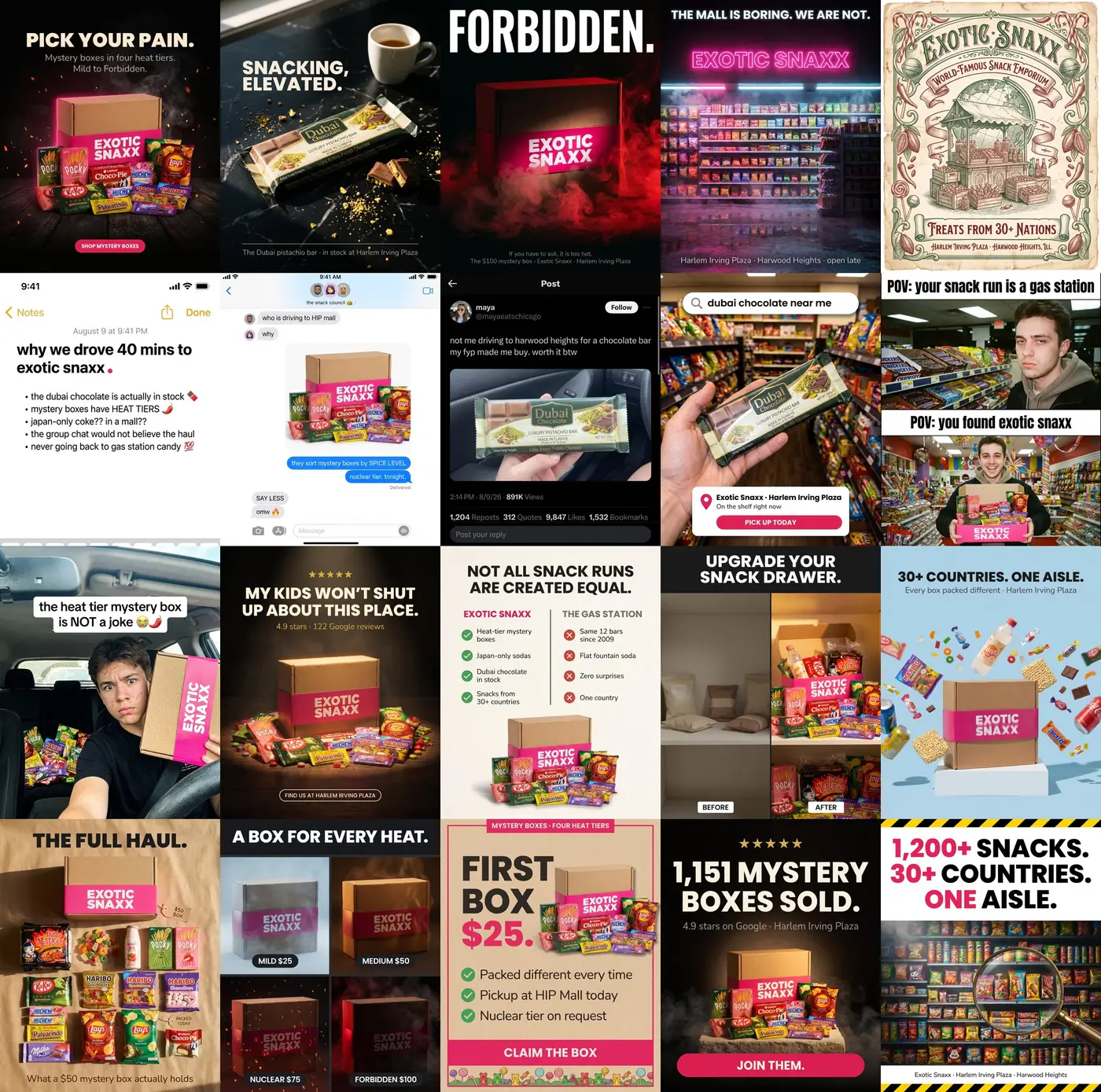
The channels. Three social videos: the taste test, the aisle walk, and walking in the door. Twenty static ad concepts for the launch campaign. We run the TikTok, Instagram and Meta accounts for the shop, and those channels gave the business a revenue stream that did not exist before. Meta, Google and local campaigns were built to point at the mall unit itself, because for a retailer like this the online order and the walk-in are the same customer at two different moments.
The deliverables
- A Shopify storefront at exoticsnaxxshop.com with 2,500 products live
- Four browse paths: by category, by country, by viral item, by spice tier
- Collect-at-the-mall checkout for pickup at the Harlem Irving Plaza unit
- SEO and blog content built on top of the catalogue
- Three social videos: the taste test, the aisle walk, walking in the door
- Twenty static ad concepts for the launch campaign
- TikTok, Instagram and Meta accounts run for the shop
- Meta, Google and local ad campaigns built to point at the mall location, produced and not yet run
How it ran
- Before the buildNo website, no online store, no search presence. 122 people had rated the shop 4.9 stars on Google, and every one of them found it by walking past the door.
- The storefrontexoticsnaxxshop.com goes live: 2,500 products, four browse paths, and collect-at-the-mall checkout for pickup at Harlem Irving Plaza.
- The content layerSEO and blog content published against the catalogue, so the store carries something a search engine can read besides product pages.
- The channelsThree social videos and twenty static ad concepts produced. TikTok, Instagram and Meta accounts running. Meta, Google and local campaigns built to point at the mall unit. Produced, not yet run.
The results
- 0 → 2,500
- Products a customer can buy online, before and after the buildMeasured August 2026
- 4.9
- Google rating across 122 reviews, every one earned before the shop had a websiteMeasured August 2026
- 3
- Social channels now running for a shop that had noneMeasured August 2026
- 4
- Ways to browse the catalogue: category, country, viral item, spice tierMeasured August 2026
- 20
- Static ad concepts produced for the launch campaignMeasured August 2026
- 3
- Social videos produced for the launchMeasured August 2026
What the numbers say
Exotic Snaxx went from zero products available online to 2,500 on a Shopify storefront, for a shop that had never owned a web page. That is the number that leads, because before it the answer to "can I buy this without driving to Harwood Heights" was no, for every product and every customer.
The 4.9 rating across 122 Google reviews is the second number, and it reads in the opposite direction to most review counts on a page like this. It is not a result we produced. It is the evidence that the demand was already there and had never been given anywhere to go. A shop that earns a 4.9 from people who wandered in by accident will convert people who arrive on purpose.
Underneath those: three social channels running for a business that had none, four separate browse paths through the catalogue, twenty static ad concepts and three videos for a shop that had never made an ad.
Why it worked
Because the destination came first. Every tactic a retailer normally reaches for, ads, email, social, local search, is a way of sending somebody somewhere. Exotic Snaxx had nowhere to send anybody, so any spend on any channel would have ended at a Google listing and a set of opening hours. The store had to exist before the traffic was worth buying.
The second reason is the browse structure, which is the part of this build that looks like nothing and did the most work. Depth is the whole proposition of a rare-imports shop, and depth is also what makes 2,500 products unusable if the only way in is a category tree. Four doors into the same catalogue means the customer who knows exactly what they want, the customer who only knows the country, the customer who only knows the TikTok, and the customer who only knows how much heat they can take all get to the same shelf.
The third is that the online store and the shop were never treated as two businesses. Collect at the mall, and ads pointed at the mall unit rather than only at the checkout, both assume the buyer will move between the two. For a single-location retailer that is not a compromise, it is the advantage a pure ecommerce competitor cannot copy.
The takeaway
If you run a store with a strong local reputation and no website, the reputation is not the asset you think it is yet. A 4.9 rating from 122 people is worth almost nothing until there is a page it can point at, a catalogue it can sell, and a way for somebody who has never driven past your door to find you. Build the destination before you buy the traffic.
And if your catalogue is deep, spend the time on how people enter it, not on how it is stored. The categories that make sense to whoever stocks the shelves are almost never the categories a customer arrives holding.
What's live right now
Questions people actually ask
Does a shop with good mall foot traffic actually need an online store?
Exotic Snaxx collected 122 Google reviews at a 4.9 rating before it had a website, and every one of those customers found the shop by walking past it in Harlem Irving Plaza. That is proof the product sells, and it is also the ceiling: the only people who could buy were the people already in the building. The store adds the customer who lives twenty minutes away, the customer who saw a product on TikTok last night, and the customer who wants to check the shelf before making the drive.
How do you organise 2,500 rare import products so a customer can find anything?
Four browse paths instead of one: by category, by country, by viral item and by spice tier. A single category tree only serves the shopper who already knows what they want. Someone hunting the sweets they grew up with browses by country. Someone who saw a drink on TikTok browses by viral item and does not know what it is called. Someone deciding how much heat they can handle browses by spice tier. It is the same 2,500 products every time, entered through a different door.
What is collect-at-the-mall checkout?
The customer buys on exoticsnaxxshop.com and picks the order up at the Exotic Snaxx unit in Harlem Irving Plaza instead of paying for shipping and waiting on it. For a local buyer that removes both the cost and the delay from the decision. It also puts a person who was going to stay home inside the shop, standing next to 2,500 products they did not order.
Can paid ads bring people into a physical store rather than just a website?
That is what the Meta, Google and local campaigns for Exotic Snaxx are built to do. The destination is the mall unit, not only the checkout page. For a shop like this the walk-in and the online order are the same customer at two different moments, so a campaign judged only on online sales undercounts what it is built to reach. Twenty static ad concepts and three social videos were produced for that campaign set.