ArgenTea
We read six competitors' ad libraries before we designed anything
A canned yerba mate brand flying blind in its own category. We mapped what everybody else was actually running, with a source on every claim, then built the brand, the store and the ad set against the gaps that showed up.
- Industry
- Retail + ecommerce
- Period
- 2026 – August 2026
The challenge
ArgenTea sells canned yerba mate direct to consumers in the United States.
That is a hard shelf. Canned yerba mate sits between energy drinks on oneside and functional soda on the other, in a chiller where every can is already shouting about clean energy and real ingredients. A new brand there is not competing for a taste preference. It is competing for one sentence of attention in a scroll, against companies that have been buying that sentence for years.
The brand was flying blind in its own category. Not short of opinions, and not short of taste. Short of information: nobody had established what the category was already saying, which of those messages had money behind them, or which angle was sitting unclaimed. Every design decision in that state is a guess wearing the costume of a decision.
What the audit found
Six competitors were profiled from their live ad libraries, with a source on every claim.
An ad library is the most underused public document in consumer goods. Acompetitor’s website tells you what they would like to be true about themselves. Their ad library tells you what they are currently paying to say, with dates attached, and it is open to anybody.
The reading method mattered more than the reading. A single creative running once is a test. The same concept running in eight near-identical variants is a brand that looked at its own numbers and decided to put weight behind that idea. Duplicate-creative counts were therefore read as scaling signals rather than as clutter, which is how six competitors turn into a ranked view of what the category believes is working.
Then two adjacent categories were pulled in as a creative reference set. Direct competitors only tell you what a category has converged on, and converging with them produces a can that disappears into the shelf it was designed to stand out from. Adjacent categories show what is possible in the format that nobody in this one has tried yet.
That is where the gap showed up, and it is the reason a specific creative exists further down this page rather than being invented in a meeting.
What we built
The brand. Brand work for the canned yerba mate line, designed against the map rather than against an impression of the category. Every decision had a reason attached that could be pointed at, which is a quieter benefit of doing the intelligence first: there is something to argue with other than taste.
The store. The Shopify store at drinkargentea.com, where the brand actually has to sell rather than present.
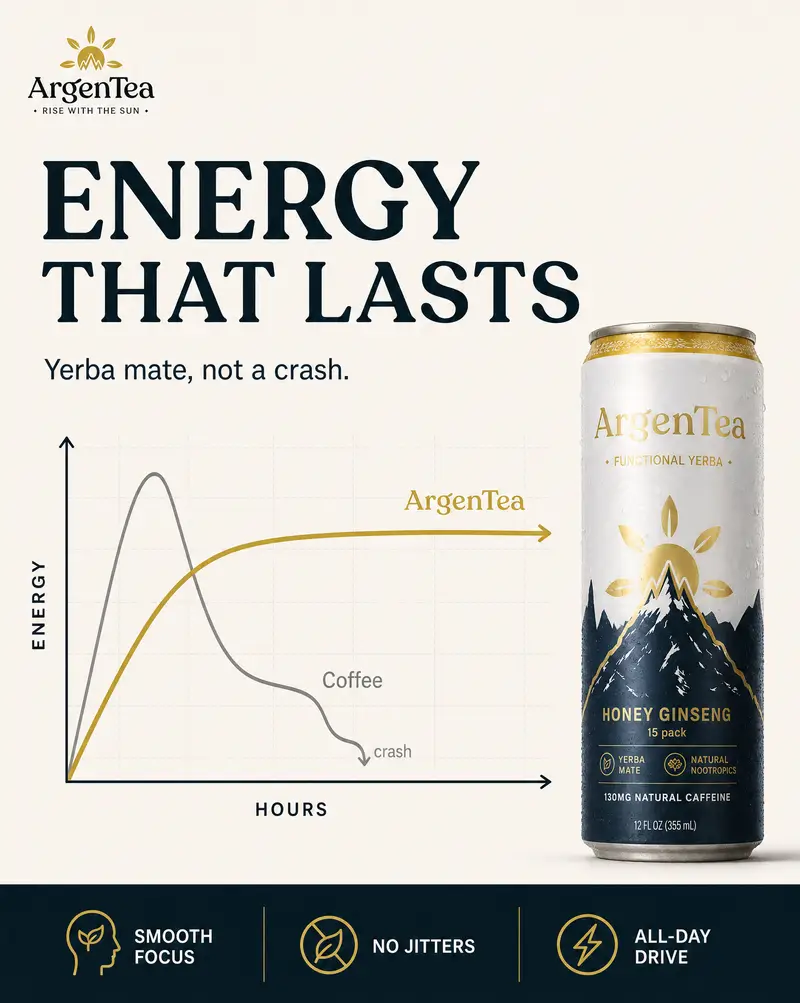
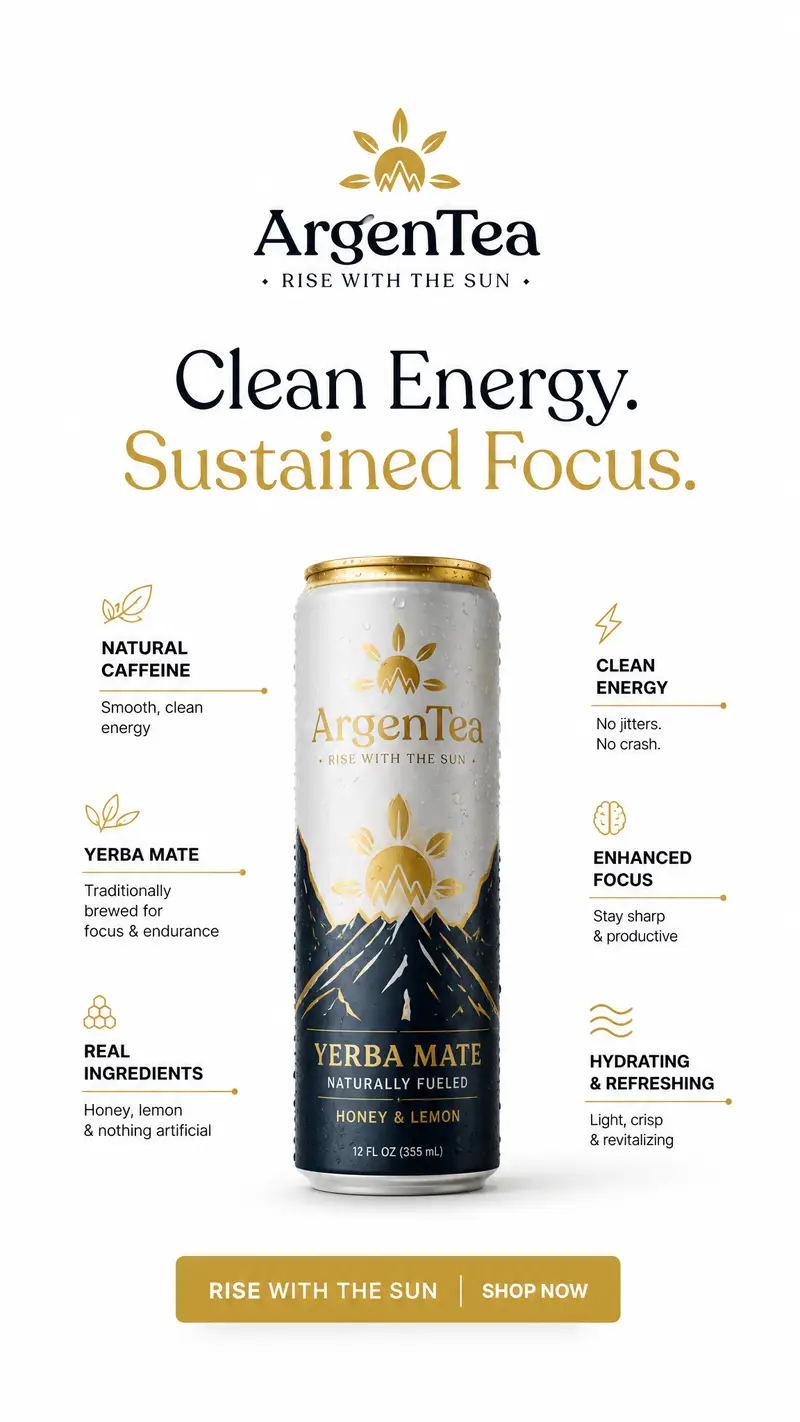
The ad set. A set of static creatives, including the Messi-lookalike concept that the reference data said the category was missing. That creative is not a celebrity endorsement and does not present itself as one. It is a recognisable cultural shorthand for the drink’s origin, running in a category that had been selling the ingredient and not the world it comes from.
The state of the creative, plainly. The imagery is AI-generated. Two variants carry garbled label text and need a pass before release. No campaign has been run from this set, so there is no cost per lead, no click-through rate and no performance data of any kind attached to any creative on this page.
The deliverables
- Six competitors profiled from their live ad libraries, with sources on every claim
- Duplicate-creative counts read as scaling signals
- Two adjacent categories pulled in as a creative reference set
- Brand work for the canned yerba mate line
- The Shopify store at drinkargentea.com
- A static ad set, including the Messi-lookalike creative the reference data said the category was missing

How it ran
- 2026Competitor intelligence pass: six competitors profiled from live ad libraries, duplicate-creative counts read as scaling signals, two adjacent categories added as a creative reference set.
- 2026Build: brand work, the Shopify store at drinkargentea.com, and the static ad set including the Messi-lookalike creative.
- 15 August 2026Creative review: the set is AI-generated, two variants carry garbled label text and need a pass before release, and no campaign has been run from it.
The results
- 6
- Competitors profiled from their live ad libraries, sources on every claimMeasured August 2026
- 2
- Adjacent categories pulled in as a creative reference setMeasured August 2026
- 2
- Creative variants carrying garbled label text that need a pass before releaseMeasured 15 August 2026
- 0
- Campaigns run from this creative setMeasured 15 August 2026
What the numbers say
Six competitors were profiled from their live ad libraries for ArgenTea, with a source on every claim, and two adjacent categories were added as a creative reference set. Those two numbers are the actual product of this engagement's first half. Everything built afterward points back at them.
Two of the finished creative variants carry garbled label text and need a pass before release, recorded on 15 August 2026. That belongs on this page for the same reason the six belongs on it. A creative review that only reports what passed is not a review.
And zero campaigns have been run from this set. No cost per lead exists, no click-through rate, no return on spend, because nothing has been in market. The brand, the store and the ad set are built. What they do when money goes behind them is not known yet, and a projection printed here would read exactly like a result to somebody skimming.
Why it worked
The intelligence came before the design, and that order is the entire method.
Most brand work in a crowded category starts with taste. Somebody looks at the shelf, forms an impression of what the category feels like, and designs into that impression. The impression is usually right about the convergence and wrong about the opportunity, because it is built from whatever is most visible rather than from what is actually being funded.
A live ad library fixes that, because it is dated and it is public. It shows what a competitor chose to keep paying for this month, and how many copies of it are running. Duplicate counts are the cheapest scaling signal available to anybody willing to count them, and almost nobody counts them.
Pulling in two adjacent categories does the other half of the job. Direct competitors tell you what the category has agreed on. Adjacent categories tell you what is possible inside it that nobody has tried, which is where the Messi-lookalike creative came from rather than from somebody's idea in a meeting.
The takeaway
If you sell a consumer product in a crowded category, spend an afternoon in your competitors' ad libraries before you spend anything on design. They are public, they are dated, and they will tell you which of your rivals is actually funding growth rather than posting.
Count the duplicates. One creative running once is a test. The same creative running eight times is a decision somebody made after seeing the numbers, and it is the closest thing to reading their reporting over their shoulder that you will ever get for free.
What's live right now
Questions people actually ask
What can you learn from a competitor's ad library that you cannot learn from their website?
What they are still paying for. A website shows what a brand wants to say. An ad library shows what it is spending money to keep saying, dated, and how many copies of each thing are in market. For ArgenTea we profiled six competitors that way and read duplicate-creative counts as scaling signals, because a brand that runs eight copies of one concept has told you which concept is working.
Why look at adjacent categories instead of only direct competitors?
Because everybody inside one category converges on the same visual language, and copying the convergence gets you a can nobody notices. Two adjacent categories were pulled into the ArgenTea reference set for that reason. The gap the reference data exposed is where the Messi-lookalike creative came from: an angle the category itself was not running.
Is the ArgenTea creative photography?
No. It is AI-generated, and this page says so rather than letting the finish imply a shoot. That is also why two variants are held back: they carry garbled label text and need a pass before release. A can with unreadable copy on the label is not a stylistic choice, it is a defect, and it goes out fixed or it does not go out.
Has any of this creative run yet?
No. Zero campaigns have been run from the ArgenTea set as of 15 August 2026, which means there is no cost per lead, no click-through rate and no return figure to report. The work on this page is the intelligence, the brand, the store and the creative. Performance is not part of it yet.