Coppr
Three product lines, built and merchandised from nothing
A copper drinkware brand that arrived with no brand, no photography and no store. All three were built end to end, and every product image was generated rather than shot.
- Industry
- Retail + ecommerce
The challenge
Coppr sells copper drinkware direct to consumers. When the work started there was no brand, no product photography and no store. Not a weak version of each of those three things. None of them.
That is a different job from a rebuild, and the difference matters. A company with a bad website has something to argue with: a page that underperforms, an image that undersells, a line of copy nobody reads. Coppr had nothing to argue with and nothing to test against. Every decision had to be made first and then carried by everything built after it.
The expensive part of launching a physical product brand is usually thephotography. Samples get shipped, a studio gets booked, a photographer and a stylist get paid for the day, and a retouching pass follows, all of it before a single unit has sold. Three product lines means three versions of that bill, which is why most new brands launch one line and promise themselves the other two later.
What the audit found
Two research passes ran before anything was designed: competitor research audits across the category, and keyword research.
Both were pointed at the same pair of questions, which are what the storeshould say and what the store should be built to rank for. Those are not one question. A store that answers only the first reads well to anyone who reaches it and is reached by almost nobody, because the words a category actually gets searched with are rarely the words a founder would choose to describe it.
That research is also what shaped the merchandising rather than only thecopy. How the three lines sit next to each other, what a first-time buyer is shown before they are asked for a card, and which product carries the range were decided from the research instead of from preference.
What we built
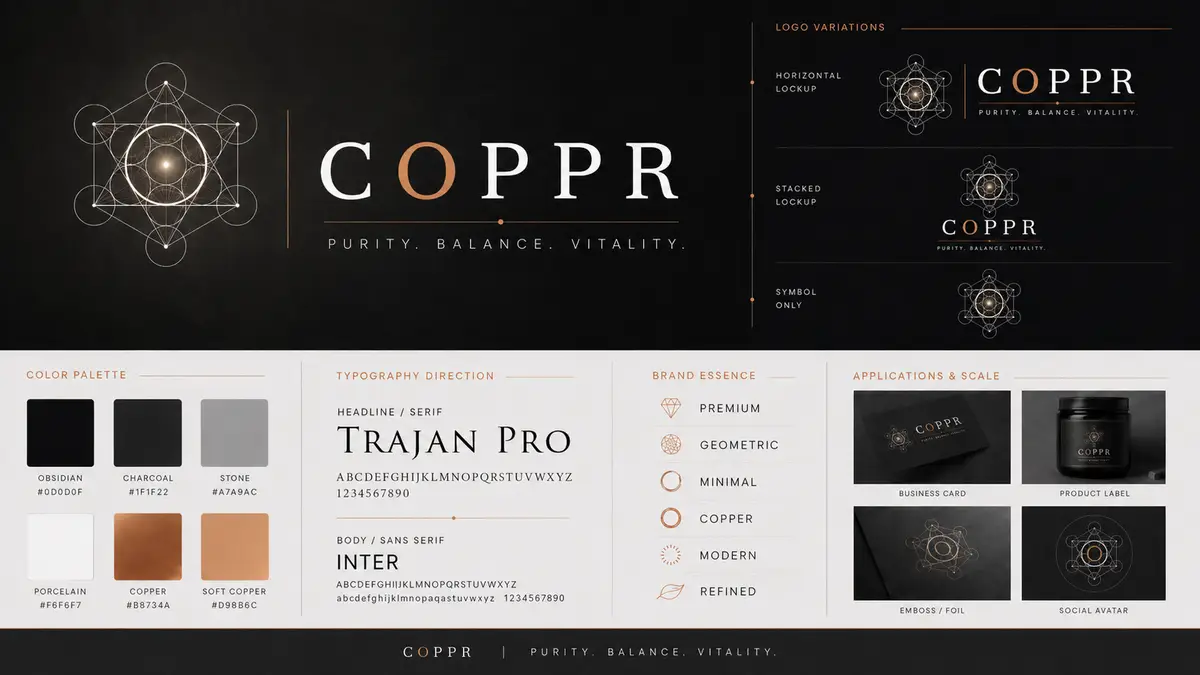
The brand. Logotype, palette and type, set on a full brand sheet. One document, settled early, that everything downstream is required to obey.
The photography. Every product image was generated rather than photographed. The shot direction, the styling and the renders were all produced in house. No studio was booked, and no samples were shipped to one.
The store. A Shopify build on a Horizon base with a custom Coppr theme, carrying all three product lines. Not a single-product landing page with two other items bolted on afterwards, which is what a range usually becomes when the store is built before the range is decided.
The flagship page. The water bottle gets thirteen sections, a five-shot gallery and a ritual bundle. A flagship page is where a first-time buyer decides whether to trust an object they have never held, and every unanswered question at that moment is a closed tab. Thirteen sections is what answering them took. The rest of the range can then afford to be shorter, because the convincing has already happened.
Where it stands. As of 15 August 2026 the store is built and merchandised, and it sits on a myshopify staging URL rather than a custom domain. That is the current status, stated plainly, and it is why this page carries counts of what was built rather than sales figures.
The deliverables
- Brand system on one sheet: logotype, palette and type
- Product photography generated rather than shot, with the direction, styling and renders produced in house
- Competitor research audits across the copper drinkware category
- Keyword research shaping what the store says and what it ranks for
- Shopify build on a Horizon base with a custom Coppr theme
- All three product lines merchandised inside that store
- A 13-section water-bottle product page with a five-shot gallery and a ritual bundle
How it ran
- 2026Brand sheet, product photography and the Shopify storefront built end to end, with all three product lines merchandised.
- 15 August 2026The store is carrying all three lines on a myshopify staging URL rather than a custom domain.
The results
- 3
- Product lines built and merchandised end to endMeasured 2026
- 13
- Sections on the water-bottle product pageMeasured 2026
- 5
- Shots in the water-bottle galleryMeasured 2026
- 0
- Studio shoots booked to photograph the productsMeasured 15 August 2026
What the numbers say
Coppr built three product lines in 2026 with the brand, the photography and the storefront all built end to end, and zero studio shoots booked to produce the product images. The water-bottle page carries thirteen sections and a five-shot gallery.
Those are counts of what was built, and it is worth saying plainly what they are not. There is no revenue figure on this page, no traffic figure and no conversion rate. As of 15 August 2026 the store sits on a myshopify staging URL rather than a custom domain, so no meaningful commercial data exists for it yet. Printing an estimate in place of a measurement would undo the reason every other number here is worth reading.
Why it worked
The order carried it. The brand sheet was settled first, because the logotype and palette get baked into the packaging, the packaging gets baked into the photography, and the photography gets baked into the product page. Work that sequence backwards and every change upstream invalidates everything downstream of it.
The photography decision is what made three lines possible at once rather than one. Generating the images instead of shooting them removed the sample shipping, the studio day and the retouching pass from each line, which is the cost that usually forces a new brand to launch narrow and expand later.
And the research came before the merchandising rather than after the launch. Competitor audits and keyword research decided what the store says and what it is built to rank for, which is two questions rather than one. A store answering only the first looks finished and gets found by nobody.
The takeaway
If you are launching a physical product brand, settle the brand sheet before you commission a single image, and treat photography cost as a decision about range rather than a decision about quality. The old maths said launch one line, prove it, then pay for the second shoot. That constraint is gone, and it is the reason Coppr built three lines instead of one.
Then check the URL your store actually answers on. A finished storefront on a staging address is a finished storefront nobody can find, and it is the cheapest thing on this entire list to fix.
Questions people actually ask
Can you launch a product brand without a photo shoot?
Coppr's product images were generated rather than photographed, with the shot direction, styling and renders produced in house and no studio booked. It works when the product is a manufactured object with predictable materials and finishes, which copper drinkware is. It works less well when the thing being sold is a person, a room or a moment, where a viewer catches what is wrong before they can name it.
What does a brand sheet actually settle?
Logotype, palette and type, in one place, before anything downstream is made. The reason to settle those first is that they get carried by everything after them. The logotype ends up on the packaging, the packaging ends up in the product photograph, and the photograph ends up on the page that has to sell the product. Changing the palette after the images exist means remaking the images.
Is the Coppr store live to the public?
As of 15 August 2026 it is built and carrying all three product lines, but it sits on a myshopify staging URL rather than a custom domain. That is the honest status. There is no sales figure, no traffic figure and no conversion rate on this page, because a store on a staging URL has not been given the chance to produce any of them.
How many product pages does a small drinkware range need?
Coppr's range is three lines, and one page in it carries thirteen sections, a five-shot gallery and a bundle. The count is not the point. A flagship page has to answer everything a first-time buyer asks before they trust a metal object they have never held, and thirteen sections is what that took here. The rest of the range can be shorter because the flagship has already done the convincing.